Each year, World Health Day reinforces a core reality about healthcare systems: demand does not decline during crises. It intensifies, shifts across segments, and places sustained pressure on infrastructure, access, and delivery models. This dynamic explains the enduring relevance of healthcare investment banking. Unlike cyclical industries driven by consumer sentiment, healthcare is shaped by demographics, disease burden, and policy frameworks. As a result, capital continues to flow through the sector even during economic downturns, supporting both stability and transformation.
The sector’s resilience is not uniform, but its ability to absorb disruption and redirect resources ensures that financial activity remains consistent across cycles.
What Healthcare Investment Banking Involves
So, what is healthcare investment banking? It is a specialized segment of investment banking that provides advisory and capital markets services to companies across pharmaceuticals, biotechnology, medical devices, healthcare services, and healthcare technology.
Core activities include:
- Mergers and acquisitions (M&A): Strategic deals to expand capabilities, enter new markets, or strengthen product pipelines
- Capital raising: Equity, debt, and hybrid financing to fund research, expansion, or restructuring
- Initial public offerings (IPOs): Public listings, particularly for biotech and health tech firms
- Restructuring: Financial reorganization during periods of stress
- Strategic advisory: Long-term positioning, partnerships, and portfolio optimization
Execution in healthcare requires sector-specific judgment. Financial models must incorporate regulatory approval timelines, clinical trial success probabilities, patent life cycles, and reimbursement systems. These variables directly influence revenue visibility and valuation, making healthcare one of the most complex coverage areas in investment banking.
Why Healthcare Investment Remains Strong
Technology is rapidly becoming central to healthcare strategies. According to the Barclays Business Prosperity Index, 89% of business leaders are actively looking to AI to solve core operational and strategic challenges, from forecasting to patient experience and cost reduction.
In healthcare, specifically, the shift is even more pronounced. A sector-focused study shows that 86% of healthcare organizations plan to increase AI investment over the next 12 months, with overall spending expected to rise by around 20%.
The priorities are clearly outcome-driven:
- 39% of leaders expect AI to improve clinical outcomes
- 38% see it reducing workforce burnout
- 33% link it to better staff retention
- 28% expect more efficient workflows and shorter waiting times
The operational implications are significant. Clinical staff currently spend a disproportionate amount of time on administrative work, as much as four hours on documentation for every hour of patient care.
AI-led automation has the potential to reverse this ratio, directly improving both care delivery and workforce sustainability.
At the same time, demand remains strong, with 74% of healthcare leaders reporting above-average pipeline strength. In this context, AI is not experimental; it is becoming essential to scaling capacity, improving efficiency, and maintaining service quality under pressure.
Sector Structure and Capital Allocation
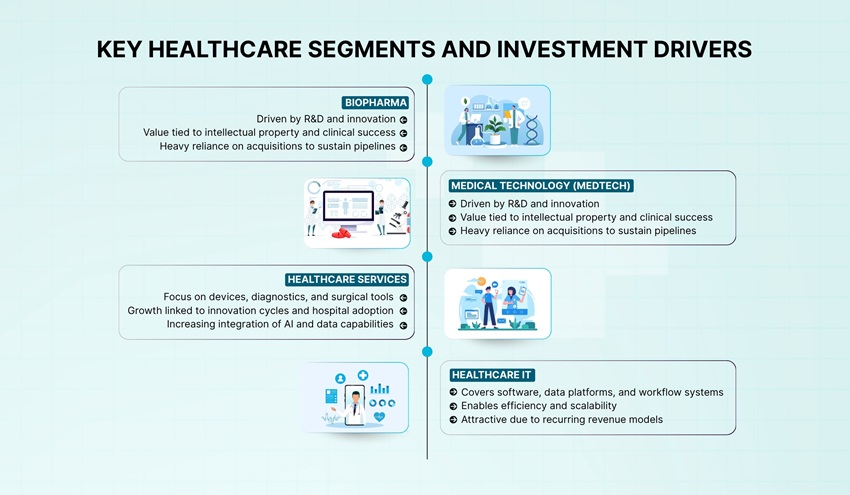
Healthcare operates across multiple segments, each with distinct economic drivers. Understanding these differences is critical for evaluating investment opportunities.
Valuation in a High-Uncertainty Environment
Valuation in healthcare follows standard financial frameworks, but with important adjustments for sector-specific risks. Common approaches include:
However, healthcare introduces unique complexities:
- Probability-adjusted cash flows (rNPV): Especially in biopharma, where revenues depend on clinical success
- Operational metrics in services: Including occupancy rates, revenue per patient, and average length of stay
- Capital structure considerations: Use of convertible debt and hybrid instruments
These adjustments reflect uncertainty around clinical outcomes, regulatory approvals, and care delivery models.
Deal Structures That Reflect Long-Term Risk
Healthcare transactions often incorporate structures designed to align valuation with long-term outcomes.
M&A remains central to growth in healthcare, driven by strategic rather than purely financial objectives. Key deal types include:
- Pipeline acquisitions: Large firms acquiring biotech companies for promising drug candidates
- Consolidation: Mergers within the same segment to achieve scale and efficiency
- Vertical integration: Connecting different parts of the value chain to improve coordination and cost control
- Divestitures: Selling non-core assets to sharpen focus
Execution requires detailed synergy analysis, including R&D alignment and operational integration.
- Licensing and Partnerships
Healthcare relies heavily on collaborative deal structures to manage risk. Common models include:
- Licensing agreements: Monetizing innovation through upfront payments, milestones, and royalties
- Co-development partnerships: Sharing costs and revenues across development stages
- Option-based agreements: Securing future acquisition rights based on clinical milestones
These structures allow companies to balance risk, capital requirements, and time to market.
- Capital Markets Transactions
Healthcare companies depend on capital markets to fund innovation and expansion.
Key transaction types include:
- Biotech IPOs: Raising capital for early-stage development
- Follow-on offerings: Additional equity raises for growth
- Convertible debt: Balancing dilution and investor upside
- Leveraged and high-yield debt: Common in healthcare services deals
Each structure reflects trade-offs between risk, dilution, and funding needs.
- Private Equity Transactions
Healthcare continues to attract strong private equity interest, particularly in segments with stable cash flows. Typical themes include:
- Healthcare services buyouts: Physician groups, clinics, and care platforms
- Devices and diagnostics investments: Stable demand and margin improvement potential
- Biopharma platforms: Building portfolios around drug development assets
These deals require a mix of traditional financial analysis and sector-specific insight, particularly around reimbursement and regulatory dynamics.
Trends Driving Investment and Deal Flow
Several structural trends continue to support healthcare investment:
- Aging populations: Increasing demand for chronic care and long-term services
- Therapeutic innovation: Growth in oncology, metabolic disease, and neurology
- Policy influence: Pricing controls and reimbursement changes shaping profitability
- Shift in care delivery: Movement toward outpatient and home-based care
These factors ensure continued capital allocation into healthcare, regardless of broader economic conditions.
The Role of Investment Banking in Healthcare System Stability
Investment banks play a direct role in maintaining and scaling healthcare systems. Their contribution extends beyond transaction execution.
They enable:
- Capital access for research, innovation, and infrastructure
- Consolidation of fragmented providers to improve efficiency
- Expansion into underserved markets
- Financial restructuring during periods of operational stress
Over the past decade, healthcare banking teams have facilitated tens of billions of dollars in financing and advised hundreds of transactions. This capital supports everything from drug development to hospital operations and digital transformation.
Conclusion
Healthcare systems do not slow during crises. They adapt, reallocate resources, and continue to operate under sustained demand. This is why healthcare investment banking remains active across market cycles. Its role is tied to the continuous need for capital, innovation, and structural adjustment within the sector.
World Health Day underscores the importance of resilient and accessible healthcare systems. Investment banking contributes to that resilience by directing capital toward the institutions, technologies, and services that sustain care delivery.
The sector’s defining strength is not immunity to disruption, but its capacity to absorb it and continue functioning. That capacity continues to support both healthcare systems and the financial activity surrounding them.
Frequently Asked Questions
Q. How are healthcare companies valued differently?
A. Healthcare companies are valued using standard approaches such as discounted cash flow and comparable analysis, with adjustments for clinical and regulatory risk. Biopharma companies often use probability-adjusted models, while healthcare services rely on operational metrics such as patient volumes and occupancy rates.
Q. What types of deals are common in healthcare investment banking?
A. Common transactions include mergers and acquisitions, IPOs, equity and debt raises, licensing agreements, joint ventures, and restructuring mandates. Earn-outs and milestone-based payments are widely used in biotech transactions.
Q. The best healthcare investment banking firms?
A. Leading firms include global banks such as JPMorgan, Goldman Sachs, and Morgan Stanley, along with advisory-focused firms like Evercore and Lazard. Specialized firms such as Jefferies and Leerink also maintain strong positions across healthcare subsectors.