Introduction
Access to capital defines the relationship between real estate projects and long-term assets. Markets reward sponsors who regard raising capital in real estate as a disciplined undertaking. But there is an increased investor scrutiny, which has led to higher standards regarding governance and transparency. In this type of environment, real estate investment is more than just financing an acquisition. It is an indicator of operational maturity, repeatability, capacity to maintain performance over cycles, and balance between the objective of returns and the fiduciary duty.
Reframing the Capital Stack for Smarter Allocation
The decisions made in capital structuring tend to either attract long-term partners or short-term players in raising capital to invest in real estate. A capital stack is a conscious risk, control, and cash flow priority hierarchy as opposed to a mere mix of funds. Secured claims and fixed repayment bring stability to the senior debt, whereas flexibility is given to the sponsors who want to take further leverage without immediate dilution by the mezzanine layers and preferred equity. At the top is common equity, which absorbs the variability in performance, and residual value, benefits the execution and timing.
These layers are used to play a different role in the capital raising of real estate strategies. Debt capital is generally attractive to investors interested in predictable income and protection of principal, whereas the preferred structures combine yield goals with partial downside protection. Participants of the equity commitments are interested in the appreciation based on the performance of the assets, the results of the lease, and the conditions of the exit, therefore, the primary aspect of capital formation is expectations.
Restructuring the capital stack promotes closer project economics and intent fit between investors. Reflective sequencing of capital helps in risk ownership and enhances transparency in the process of fundraising, as well as aids in repeatability through the market cycles, which strengthens capital raising as a disciplined and repeatable skill and not a one-time transaction.
Investor Profiles Driving Capital Flows
Determination of capital sourcing in real estate is fundamentally about who is involved. Changes in the composition of the investors are reorganizing the way capital is raised to finance real estate, whether in speed, structure, or strategy, based on the asset type.
Institutional allocators are still central to massive capital raising, with scale expectations, institutionalized governance, and risk parameters. Their participation can also define the architecture of the deals at an early stage, which is reflected in the level of reporting and discipline in capital deployment.
Families and high-net-worth investors seeking customized exposure have opened up the participation of private wealth in a broadened sense. The group does not focus on standardized fund mechanisms but on control, alignment, and transparency when raising capital to invest in real estate.
Smaller pooled vehicles and retirement-linked capital provide additional complexity. These investors focus on predictability, preservation of capital, and transparency of when cash will flow, which supports the necessity of differentiated engagement strategies.
- Family offices usually want extended holding periods and direct participation in major decision-making.
- High net worth investors tend to appreciate a stable income and capital visibility.
- Aggregated vehicles prefer structuring and standardized disclosures.
Effective capital planning is getting more flexible to such profiles, noting that long-term fundraising is pegged on the alignment of structure, communication, and governance to investor purpose, and not on any one capital story.
Structuring the Real Estate Investment Offering
At the structuring stage, capital formation tends to either succeed or fail. The perception and evaluation of opportunities is influenced by decisions made regarding the legal form, capital commitments, and investor rights. In raising capital to invest in real estate, it is important that the sponsors put the asset strategy in definite economic terms that specify ownership, precedence of cash flow, and governance. Even the quality of documentation is important as the underlying asset, because structure will be the initial indicator of discipline and credibility.
Various underlying decisions usually form the basis of this phase.
- Choosing the legal vehicle that suits the length of the asset and the base of investors.
- Definition of levels of capital and sequencing of returns to show allocation of risk.
- Effective definition of sponsor roles and decision-making authority.
In addition to structure, disclosure is one of the key drivers of capital readiness. The financial models, assumptions, and risk factors should be provided in a manner that enables the investors to assess the downside exposure as well as the projected results. In the case of teams that are dedicated to funding real estate, such transparency at an earlier point cut down on the friction at the latter part of the process and facilitates re-entrance as opposed to a one-time investment.
Other details that may be perfected in this stage include:
- The language of disclosure is in accordance with the regulatory expectations.
- Minority paths to the market based on the naturalistic market conditions.
The final review process brings these elements together. Legal and financial consultants confirm the consistency between strategy, documentation, and investor communications. That discipline guarantees that the ability to raise capital to invest in real estate is a repeatable ability and not a deal-specific undertaking, and puts the offerings in a better position to execute more smoothly and establish capital relationships over the long term.
Case Study in Institutional Capital Deployment
A successful institutional platform found a way to raise capital for real estate investments in 2025 by refocusing its transparency and communication strategies for investors. The sponsor initiated a series of organized investor briefings, which focused on the projection of cash flows and governance practices that were in line with the requirements of the pension funds and other long-term allocators. Subsequently, the platform achieved an over 18 percent commitment, surpassing its target in a span of six months, enabling it to substantially increase its capital base before it was due to make acquisitions. This has been reinforced by the macro market momentum in the sense that real estate investments in India by institutions were at an all-time high of 8.47 billion dollars in 2025, with a year-on-year growth of 29 percent, according to a Colliers India report.
The case study demonstrates how disciplined participation and believable disclosure structures can help reduce fundraising periods and create investor confidence in raising capital on real estate through several types of assets, especially in competitive markets.
Technology, Data, and Trust Building
Investor trust often begins before direct engagement. Digital infrastructure has become the initial indicator of discipline and seriousness in raising capital to invest in real estate. The use of secure portals, standard reporting formats, and structured data flows determines the risk perception of the investor towards governance, long-term purpose, and risk. Conversations change not on the verification but on the strategy when information is readily available and is organized logically.
The perception is backed by an underlying practicality. Technology helps sponsors who are involved in raising capital in real estate to cope with the complexity of the task without overwhelming stakeholders. Performance information could be refreshed regularly; assumptions could be tracked across models, and disclosures could be up-to-date across various groups of investors. This will decrease the friction in diligence and contribute to the more articulate congruence between stated results and delivery strategies.
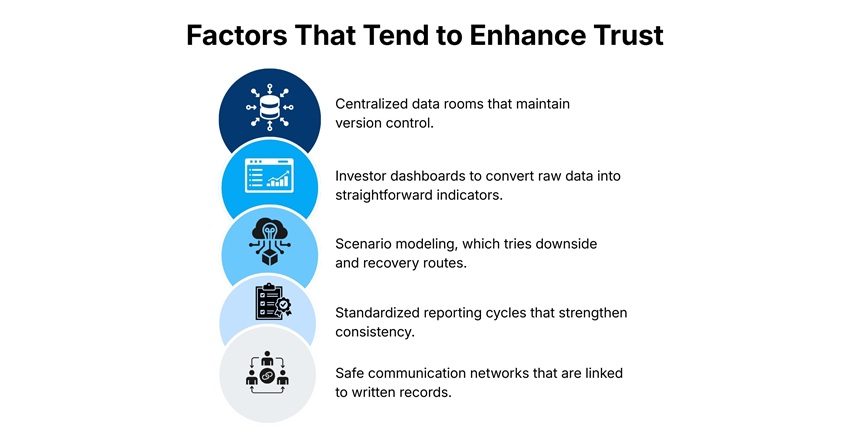
Factors that tend to enhance trust are:
- Centralized data rooms that maintain version control.
- Investor dashboards to convert raw data into straightforward indicators.
- Scenario modeling, which tries downside and recovery routes.
- Standardized reporting cycles that strengthen consistency.
- Safe communication networks that are linked to written records.
Trust is built whenever systems operate silently in the background. Consistent information protocols enable capital discourse to be concerned with the course of the portfolio and risk positioning and strengthen credibility across funding cycles as opposed to a solitary raise.
Conclusion
Raising capital effectively in real estate is based on discipline, credibility, and long-term alignment, and not momentum. Sponsors who approach capital formation as a sustainable capability build resilience through market cycles. Efficient processes, well-considered communication, and repetition of structures reinforce the capital raising of real estate investment and aid in the sustainable growth of the portfolio and in keeping the confidence of the investors. In the long run, such a strategy will make fundraising not sporadic but a constant source of success.
Frequently Asked Questions
Q. How do real estate sponsors attract investors?
A. Sponsors attract investors by presenting strong investment opportunities, clear financial projections, transparent risk analysis, and a proven track record. Professional pitch decks, detailed financial models, and credible market research also help build investor confidence.
Q. How much capital is typically required for a real estate project?
A. The capital required depends on factors such as property type, location, development scale, construction costs, and financing structure. Projects usually combine multiple funding sources to cover acquisition, development, and operational expenses.
Q. What role does due diligence play in real estate capital raising?
A. Due diligence ensures that all financial, legal, and operational aspects of the project are thoroughly evaluated before capital is committed. It helps investors verify assumptions, assess risks, and confirm the credibility of the project sponsor.