Introduction
Financial statements are an important basis for assessing the performance of an organization, but these statements are mostly interpreted as absolute and not conditional. Reported figures entail set rules and timing options as well as measurement assumptions that affect results. These factors constrain financial statement analysis and require analysts to examine it at more than the surface-level accuracy. Clarity of such limitations enables the financial data to be used as informed input instead of blind evidence.
Structural Constraints Within Financial Reporting
Financial statements are organized by inflexible reporting structures that define what is to be reported and how it should be presented. The structures are subject to a particular set of templates, classification standards, and aggregation of necessities, which may limit the clarity of the underlying economic data. As an illustration, the balance sheet should categorize assets and liabilities into broad categories that hide important information about the quality of resources or repayment periods. This formal structure drives subtle business realities into the simplified boxes, and when trying to derive subtle changes in performance or risk, the constraints of the financial statements can be quite clear.
One of the major limitations is that such reports do not record information on an ongoing basis but at specific intervals or time intervals. Quarterly or annual snapshots are common tools analysts work with but can be affected by timing quirks rather than significant trends. A 2026 financial reporting benchmark on standards of accuracy shows that even major companies record error rates in transactions of about 2 to 3 percent, indicating that structural reporting processes may not yield accurate figures despite attempts to automate them.
The dependence on standard forms also influences the comparison of various industries and jurisdictions. Standardized requirements are unable to capture the sector-specific dynamics, in addition to being unable to adapt to the local business practices, regulatory nuances, or cultural reporting expectations. These organizational limitations water down the utility of financial reports in-depth comparison and strategy.
Structural rigidity within reporting frameworks creates a natural handoff to the next layer of complexity. As standardized formats and aggregation rules leave significant room for managerial discretion, estimation choices turn into a critical source of analytical uncertainty.
Don’t Walk into the Room Unprepared
Get IBCA’s investment banking interview guide and get the edge you need.
Download Now →
Accounting Judgments and Estimation Risk
The decisions that management makes concerning estimates, assumptions, and valuations provide some degree of subjectivity that the financial statements’ users must be aware of. Estimates like provision of doubtful accounts, impairment of assets, pension schemes, and value of complex financial instruments are subjective in nature. They place a lot of reliance on the judgment of managers regarding future events that are uncertain and do not fall within the reach of accurate measurements. Since reported profits, asset values, and liabilities are influenced by these kinds of inputs, the limitations of financial statement analysis become evident as soon as such estimates vary between the two periods by a significant margin without an evident business or economic motivation. This uncertainty must be considered when earnings and financial positions are interpreted by investors and analysts.
Estimation processes are regularly evaluated by professional auditors to determine their reasonableness in context. The research on Accounting Estimates in Financial Statement Audits states that the increased complexity of valuation models and less transparent disclosures make the process of assessing estimates more difficult on the part of the auditors and increase the risk of a material misstatement. The research points out that the quality of audit increases with the increase in complexity, relying on professional skepticism and technical skills, and that estimates form an important source of uncertainty in the reported amounts.
This estimation risk also suggests that the financial statements can show a distorted picture of economic reality, especially when the market conditions are volatile, or the forecasts do not match the results. Practically, the wrong estimation of the proper estimate may result in changes in later periods that obscure the trend analysis and valuation models.
The causes of estimation risk are:
- Unobservable material inputs to fair value measurements that demand a lot of judgment.
- Dynamic market environments that complicate future cash flows.
- Limited historical information to make assumptions on new business lines or products.
- Differences in management risk appetite, which influence discretionary estimates.
A clear understanding of estimation risk preconditions essential when analyzing these estimates. Although estimates may be reasonable when used individually, their usefulness reduces as soon as they are compared across firms or time when reporting decisions and standards differ.
Historical Orientation Versus Current Market Reality
Financial statements primarily reflect historical activity not current market dynamics. Since these documents are summaries of transactions during a given period of time, they might not capture sudden changes in the economy, competition, or customer demand. This historical emphasis highlights one of the key weaknesses of financial statements: the measures of value are anchored on past transactions, despite the current market indications taking a different path. Therefore, the limitations of financial statement analysis are further enhanced in the context where timeliness and relevance are paramount to interpretation.
- Report timing versus business reality
Markets react continuously, while financial reporting occurs quarterly or annually. The firms can have some drastic changes in the pricing power, cost structures, or risk exposure between reporting dates that are not visible in the published statements. This lag can compel analysts to rely on historic pointers to assess short-term performance or resilience.
- Valuation differences and economic relevance
Historical cost cannot be the economic utility or market value of the assets that have been recorded. Inflationary pressures, technological obsolescence, or regulatory changes can have a material impact on asset values that are not reflected immediately in financial statements and therefore undermine ratio analysis and peer comparison.
- Decision-making under uncertainty
Future indicators are becoming vital in strategic and investment decisions. Historical reports, when viewed as independent inputs, have the potential to delay the recognition of emerging trends, which supports the practical shortcomings of financial statement analysis.
Combined, the historical orientation of financial statements requires users to complete the information presented in financial statements with current market knowledge to ensure they do not make decisions that have been anchored to past performance.
Illustrative Example Using a Simplified Excel-Based Analysis
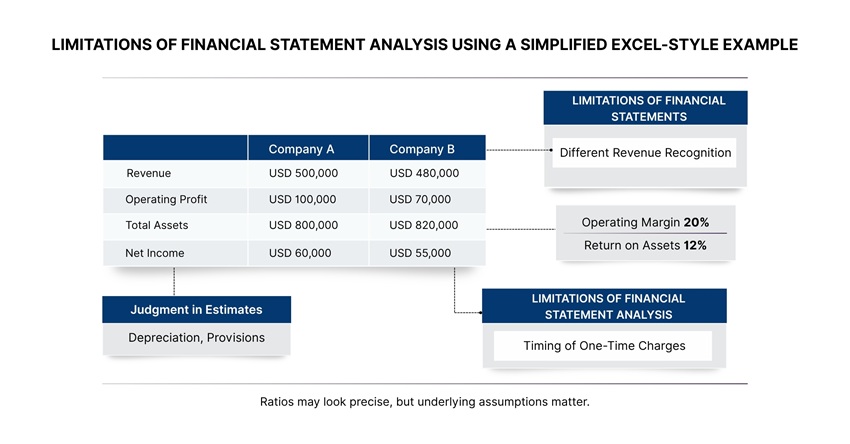
Suppose one has a simplified Excel spreadsheet that is used to compare two companies through publicly reported data. The worksheet contains revenue, operating profit, total assets, and net income, and then the ratios are calculated by the author uses the operating margin and the return on assets.
Company A seems to be more profitable at first sight as it has a greater operating margin. But the financial modeling in Excel is fully based on reported statistics. It does not consider the variations in revenue recognition policies, asset valuation policies, or a single adjustment of expenses. As a result, the ratios can be objective and yet represent the shortcomings of financial statements.
The example shows that analysis based on a spreadsheet may be used to arrange and compare data in an efficient way, but it is limited by the quality, timing, and assumptions of underlying financial reports.
Limited Visibility into Business Quality Drivers
Financial statements capture only the assets and activities that pass high standards of accounting recognition. A lot of factors that reflect fundamental sources of competitive advantage, including internal know-how, brand equity, corporate culture, customer loyalty, and other intellectual capital, are not realized. These untold factors tend to determine future profitability, but they are not visible in the traditional accounting models, and thus, the stakeholders tend to make decisions on the basis of incomplete information instead of a thorough assessment of the enterprise’s strength.
A strong pointer to this disparity is the latest Global Intangible Finance Tracker (GIFT™) 2025 data, which reveals an estimated 83 percent of the global intangible asset value is not reported on company balance sheets due to current reporting standards not requiring the recognition of most types of intangible value.
Supplemental disclosures or external metrics often force investors and analysts to formulate quality drivers. The omission of intangible value in reporting book value can considerably undervalue the overall economic value of a business, particularly in knowledge-intensive industries, including technology, services, or finance.
The resultant effect is the constraints of financial models, which make it hard to consider the long-term outlook and competitiveness. Without the visibility of these drivers, financial statement analysis may wrongly reflect the strengths underlying it, understating future cash flows related to human capital, innovation, and relational assets.
Conclusion
Financial statement analysis is crucial, but its usefulness is determined by the ability to identify its limitations. The inability to conduct proper financial analysis is characterized by structural reporting regulations, use of estimates, focus on the past, and non-financial blind spots. Differences in accounting procedures also reduce comparability, which adds to the limitations of financial statements. The recognition of these limitations promotes more careful interpretation and helps make decisions that weigh reported outcomes with contextual decoding instead of turning the analysis to mechanical review only.