Introduction
Private credit has grown more selective, emphasizing recoverability over reach. Asset-based structures fit squarely within that discipline. Asset-based lending is a practical funding source when companies are in expansion, change, or turbulence. This strategy has been popular among lenders and investors who want to have transparency and downside protection. The model influences the manner in which capital is invested in credit markets as asset-based lending companies and asset-based lending private credit strategies grow.
How Collateral Anchors Credit Decisions
Lenders are interested in tangible assets, as they act as a backup in case cash flows are not certain. The main idea of Asset-secured credit is that the value of collateral held by a borrower directly determines the extent of credit that can be extended and on what terms. Each of the receivables, inventory, equipment, and real estate is valued in accordance with the market conditions and liquidation situation. These appraisals define the amount of the borrowing base, which is the maximum amount that a lender will release.
The underwriting in this space is one that regularly reevaluates the collateral value and risk factors. Loan contracts usually include periodic borrowing base certificates that lenders use to adjust credit lines as collateral values fluctuate. The strategy minimizes the risk of downturns since the assets may be sold or repositioned in case the borrower defaults. The asset convertibility, market liquidity, and industry-specific drivers are also factors that lenders use to risk-set advance rates and covenants.
Components that can be borrowed are:
-
Receivables advance rate of customer invoices, credit quality, and past payment history.
-
Ease of sale and shelf life of goods as an inventory valuation threshold.
Master LBOs, M&A strategy, and valuation nuance with advanced interview guide.
Download Now
Borrower Profiles and Use Cases Across Industries
The significance of collateral discipline becomes more tangible when examined through the industries that apply asset-backed structures to address working capital strain, growth timing gaps, and balance-sheet limitations.
Some industries rely on the financing approach as a good source of funding when traditional cash flow lending is not sufficient. These facilities are commonly used by real estate and construction companies to offset the delays between project and payment schedules, as property and inventory can be powerful collateral that is evaluated and financed by lenders. This is also helpful to large retailers with huge inventories who require working capital before the high sales seasons. A global market analysis report of 2025 estimates the Asset-secured credit market to reach USD 815.3 billion in 2025 and to grow to USD 2314.9 billion by 2035 with a compound annual growth rate (CAGR) of 11.0% during the period.
Medium-sized manufacturers and distributors have a different picture to paint. These companies may not be eligible to take the conventional unsecured loans because they have fluctuating cash flows, but have large receivables or equipment to collateralize. In such situations, specialized lenders develop structures that are sensitive to the value of such collateral assets and that provide flexibility to the borrower to finance inventory purchases, payroll, or invest in near-term growth. The breadth of use cases is also emphasized by the fact that similar structures are used in nonprofits or mission-driven organizations in which large pledged assets are used to increase the liquidity in the delivery of programs without changing the governance of the operations.
In the private markets, the sponsored corporate borrowers use collateral-backed private credit solutions during restructuring or strategic transitions. This kind of financing is especially popular among firms in industries whose revenues are cyclical, including transportation or energy services. Borrowers tend to adopt these forms since they are not based on past profits that may be unstable in such businesses, but on the asset liquidity and value assessments based on risk-adjusted values. The types of borrowers that are likely to borrow in these facilities are:
-
Companies that possess assets that are subject to change in their cash flow but have receivables or equipment collateral.
-
Retail and wholesale businesses are expanding and require seasonal working capital.
-
Real estate developers operating on long-term projects.
-
Operational restructuring or expansion planning of corporations.
The Expanding Role of Asset-Based Lending Companies
Asset-based lending companies have expanded their role within corporate finance beyond niche markets. These lenders have become large sources of flexible capital to firms that can be considered too cyclical or capital-intensive by traditional lenders. And due to the constant demand for financing secured by receivables, inventory, equipment, and other tangible assets, the global asset-based lending market has kept on growing in recent years. This expansion shows the expanding capability of lenders to package credit based on intricate collateral pools and financing liquidity requirements in sectors where the credit strength of cash flow is not necessarily a match to historical bank underwriting requirements.
The withdrawal of some traditional banks from certain areas of commercial lending has also contributed to expansion since this has left room for specialized lenders who know how to value assets, monitor, and liquidate them. Such companies tend to combine funding with more intense risk control and customized servicing and would be attractive to companies experiencing fast expansion or seasonal funding shortfall. The collateral-based lenders are emerging as critical components in credit ecosystems as more capital is invested by private investors in credit strategies to offset the risk and to have access to capital beyond the traditional sources.
-
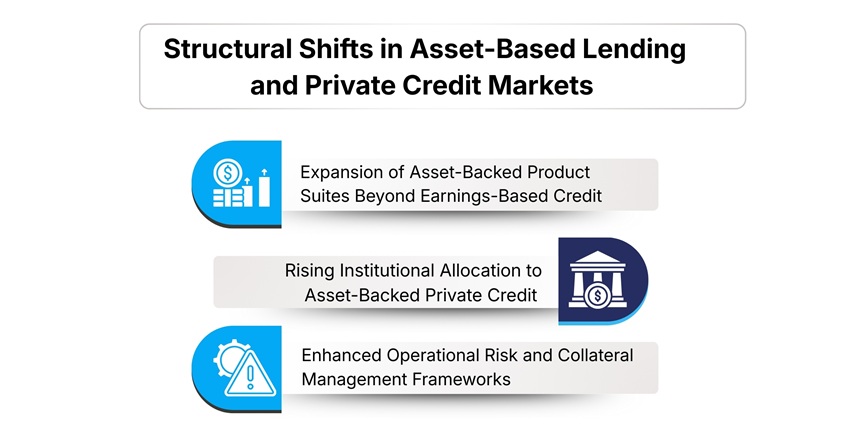
Established companies are expanding product offerings to product suites with lines of credit, equipment financing, and structured receivables financing anchored on real asset value, and not on historical earnings, to better enable credit-limited businesses to access them.
-
Investors are increasing allocations to asset-backed credit strategies within asset-based lending private credit, supported by steady expansion across private credit markets. According to Preqin’s 2025 Private Capital data, global private credit assets under management have reached approximately USD 1.7 trillion, reinforcing institutional demand for lending formats that emphasize collateral quality, downside protection, and portfolio diversification.
-
Practices of operational risk assessment and collateral monitoring taken by these companies are becoming more sophisticated in response to competitive pressures and the demand to have strong controls in a higher interest rate and stricter bank credit environment.
As these firms broaden their underwriting capabilities, product structures, and monitoring frameworks, their lending activity increasingly migrates from standalone balance-sheet financing into institutional portfolios, positioning asset-backed strategies as a growing pillar within private credit allocation.
Asset-Based Lending Within Private Credit Allocation
Private credit portfolios are tilting toward collateral-backed structures with defined downside protection, moving away from dependence on growth-driven underwriting. Asset-based private credit lending is ideal for this approach. It links the capital deployment to physical collateral and develops a lending strategy based on observable enterprise activity as opposed to estimated cash flows.
In private credit allocation, asset-backed strategies tend to be between senior direct lending and opportunistic credit. The attractiveness is in being predictable. Advance rates, collateral audits, and borrowing bases bring a sense of discipline, which makes the lender's control more aligned with day-to-day business performance. This is why the strategy is applicable during times of uneven growth or changing demand cycles.
Institutional allocators consider asset-secured credit as a means of stabilizing returns and remaining exposed to operating businesses. Asset-backed facilities are focused on control, reporting cadence, and recovery planning as compared to covenant-light structures. The features facilitate the objectives of portfolio construction based on the preservation of capital as well as the generation of income.
The existence of collateral-based lenders, which are specialized, further supports the role of this strategy in private credit. Their experience in operations, understanding of the sector, and the active management of collateral enable asset-backed lending to scale without affecting the underwriting discipline, which strengthens the argument that it is a sustainable element of contemporary credit portfolios.
Conclusion
Financing structures tested in the market have evolved to become practical tools with discipline and rigor of operation. Its scalability to meet business demands, tight control of risk, and its adaptability to evolving credit environments are some of the reasons why it continues to gain momentum. Further optimization of underwriting and monitoring is likely to enhance its status as a stable source of capital in diverse economic cycles.