A stock pitch is a formal investment presentation that explains the case for buying or selling a specific equity security. It is a structured analysis that precisely combines:
- Qualitative business research
- Quantitative financial modeling
- Catalyst-driven timeline analysis
- Rigorous valuation methodology
These are the core components that help to demonstrate that a security is materially mispriced relative to its intrinsic value. The pitch translates market inefficiency into a quantifiable investment opportunity with defined risk parameters. In this guide, we will look at a case study to show you how it works in the real world of 2026.
What is a Stock Pitch?
A stock pitch is a concise investment proposal that recommends buying or selling a specific security based on a combination of fundamental analysis, valuation, and specific catalysts. Unlike a standard equity research report, a pitch is designed to be "actionable," meaning it provides a clear timeline and price target.
In professional settings, a stock pitch serves several functions:
- Hedge Fund/Investment Banking Interviews: It is the primary tool used to assess an applicant’s "investment acumen" and ability to handle pressure.
- Portfolio Management: Analysts use these pitches to compete for capital allocation within a fund.
- Risk Management: By documenting the original thesis, investors can objectively assess whether to trigger a stop-loss if it breaks.
Step-by-Step Guide to Structure Your Stock Pitch
When you learn to do a pitch, you are learning to think like an owner. The analysis centers on the business itself, not just the ticker symbol. Every great pitch follows a logical path. Here is the process used by top-tier analysts.
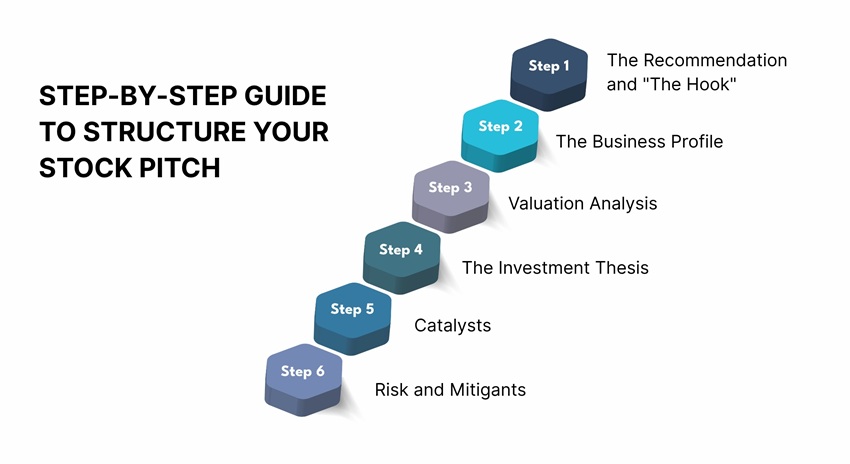
1. The Recommendation and "The Hook"
Start with the vital statistics: Company name, ticker, current price, target price, and the projected upside/downside.
Example: "I am pitching a Long position on VertiCore Systems (VCS). Currently trading at USD 85, I have a 12-month price target of USD 120, representing a 41% upside."
2. The Business Profile
Explain how the company actually makes money. Focus on the revenue mix and market share. Avoid generic descriptions; instead, identify the "Economic Moat". It is the structural advantage (e.g., high switching costs or proprietary IP) that prevents competitors from eroding margins.
3. The Investment Thesis
This is the "Why." A strong investment thesis typically centers on two to three pillars where the consensus view is demonstrably incorrect. In 2026, this often involves "Margin Resilience". It is the ability of a firm to pass on inflationary costs to customers without losing volume.
Example: While the market views VCS as a cyclical hardware provider, their shift toward a ’Cooling-as-a-Service’ (CaaS) subscription model is being ignored, leading to an undervalued recurring revenue stream.
4. Valuation Analysis
You must prove the value using multiple methodologies. Professional analysts typically use a Discounted Cash Flow (DCF) analysis and Comparable Company Analysis (Comps).
- DCF: Calculate the present value of future cash flows using a Weighted Average Cost of Capital (WACC). DCF estimates intrinsic value by discounting projected future cash flows to present value using the WACC, showing how much the business is fundamentally worth.
- Comps: Derives relative value by benchmarking the company’s EV/EBITDA or Price-to-Earnings (P/E) multiples against peers, indicating whether the current price is at a premium or discount.
5. Catalysts
A catalyst is a specific event that will force the market to recognize the value you’ve identified. Without a catalyst, a stock can stay "cheap" forever.
- Hard Catalysts: Earnings releases, M&A announcements, or regulatory approvals.
- Soft Catalysts: New product launches or management changes.
6. Risk and Mitigants
To provide a balanced stock pitch, you must identify what could go wrong (the "Bear Case") and why those risks are either unlikely or already priced in.
Pro Tips for Your Stock Pitch
- Avoid the "Average": Do not pitch a company just because it is "good." Pitch it because the market thinks it is "bad" or "average" when it is actually "exceptional."
- The 3-Minute Rule: You should be able to deliver your core thesis in under three minutes. If you can not explain how to do a stock pitch for your company at that time, the thesis is too complex.
- Know Your Bear Case: In an investment banking interviews, the most common question is: "Tell me why I should short this stock instead." If you have not researched the downsides, your pitch loses all credibility.
- Use Numbers, Not Adjectives: Instead of saying "revenues grew a lot," say "revenues grew 22% YoY, outperforming the sector average by 400 basis points.
2026 Market Insights & Data
The market in 2026 focuses on two things: Margin Resilience and Infrastructure AI. Investors want companies that can maintain steady profits even when costs rise. This reflects a sustained high-cost environment that has compressed margins across sectors.
A great stock pitch case study is likely to focus on "The Power Behind the AI." Currently, the global AI market is undergoing explosive growth. Software is leading in terms of growth with over 40% CAGR while hardware is holding a dominant market share due to heavy investment in AI infrastructure, chips, and data centers. By 2034, the total AI market is expected to surpass USD 2.4 trillion.
This means you must show that your company is not overleveraged. If a company needs cheap loans to survive, your case should probably be a "Sell." Global shifts toward building factories closer to home (regionalization) are also creating big winners and losers, making them perfect for a stock pitch.
Realistic Case Study of Stock Pitch
This stock pitch example presents a strong recommendation for Jazz Pharmaceuticals (JAZZ). It focuses on why the stock appears overvalued relative to its fundamentals and key risks.
JAZZ is currently overvalued by 50–70% because the market is relying on overly optimistic assumptions about its future sales and pricing power.
- Generic entry timing: In a 2026-style scenario, the market assumes late-cycle Xyrem- related products will enjoy strong pricing into the mid-2020s, but earlier generic and biosimilar competition is more likely, which would compress earnings and reduce the implied fair value by approximately 10%.”
- Pricing power: Following industry wide pressure on drug pricing and the Brent Saunders ‘price hike limit’ precedent, JAZZ is unlikely to increase prices by more than low single digits, which slows the growth toward peak sales estimates.
- Unrealistic sales targets: Market expectations for Vyxeos and JZP 110 are too optimistic; uptake may be slower and peak sales lower than currently priced in.
Key events that could trigger a price correction include additional Xyrem generics winning FDA approval and weaker-than-expected early sales from Vyxeos.
While a “perfect storm” of pipeline success, for drugs such as JZP-258, could push the stock up nearly 35% (to around USD 200), investors can manage this risk by maintaining a hedge on the short position. Practical hedges include buying call options on JAZZ or investing in a broader biotech index fund to offset potential downside.
Conclusion
Learning how to do a stock pitch is the ultimate skill for any investor. It replaces speculative thinking with a structured, professional framework. Using a solid stock pitch example as your guide will help you develop a more structured and professional approach to equity analysis. The key is to start with a focused thesis and consistently question prevailing market assumptions.
Frequently Asked Questions
Q. What is the most common mistake in a stock pitch?
A. The most frequent error is focusing entirely on historical performance. Professional investors care about the future. A stock pitch that relies solely on the last three years of financial statements without projecting future cash flows is considered incomplete.
Q. How are valuation multiples used in a stock pitch?
A. Multiples (like P/E or EV/EBITDA) are used to compare a company’s value relative to its peers. For instance, if a company trades at 10x earnings while its competitors trade at 20x, the pitch would focus on why that "valuation gap" exists and how it will close.
Q. Is a "Sell" pitch different from a "Buy" pitch?
A. A Buy pitch argues the market is undervaluing a company, while a Sell pitch argues the market is overvaluing one. Both require a mispricing argument, a catalyst, and a price target. The logic is the same. The direction is opposite.
Q. How long should a written stock pitch report be?
A. A professional written pitch or "investment memo" is typically 2 to 3 pages. It should be dense with data, including tables for valuation and charts for price performance, avoiding unnecessary prose.