Introduction
Organizations still lack the idea of the reasons why mergers and acquisitions fail, despite decades of deal-making experience. The financial models tend to promise scale, efficiency, and market access, but when implemented, there are underlying structural flaws. Strategy drifts, leadership incentives come into conflict, and integration risks are revealed late. A disciplined M&A policy requires intention before it gains momentum. Strong M&A deal strategy treats alignment, governance, and post-close integration as value drivers, not mere administrative tasks in today’s complex and uncertain markets.
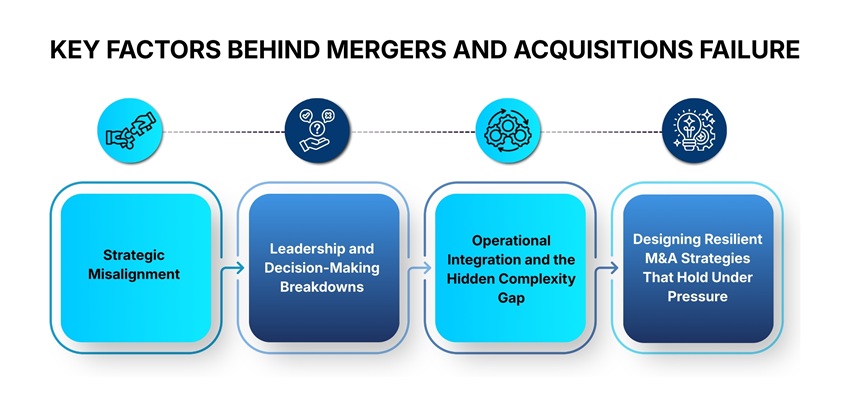
Strategic Misalignment at the Core of M&A Failure
Companies usually believe that financial reason is all that will make a deal successful. However, a considerable part of mergers is not successful due to initial misalignment of the underlying objectives. A Forbes report on M&A performance in 2026 estimates 70 to 75 percent failure to deliver anticipated value in the course of an acquisition.
Strategic misalignment manifests itself when the business model, market focus, or long-term objectives of the target do not complement those of the acquirer. The result of that disconnect is all too often unrealistic synergy expectations and integration plans that have little similarity with the realities of operations. Resource allocation, talent retention, and post-deal project prioritization are also not well aligned. A basic incompatibility in purpose, even with the best due diligence, cannot be counterbalanced by the fact that leadership is not united behind a shared strategic vision.
Organizations that have set common goals upon entry into a transaction are more likely to achieve performance milestones after integration.
Leadership and Decision-Making Breakdowns
A merger might seem like a good move on paper, but the reason why mergers and acquisitions fail is mainly due to leadership issues. The failure of leadership usually starts with the executives not taking the coordination needed during a post-close process very seriously. Confusion of ownership on integration priorities retards decision making process, and mixed signals by senior leaders confuse teams. In the long term, the ambiguity that is not resolved undermines trust and execution discipline.
Governance systems are designed to help balance this risk, but they often fail. Boards can be extremely concerned with the deal approval, but are less concerned with post-close control. In cases where the mechanism of challenges is poor, the assumptions are not tested, and the risks are not operational, but are theoretical.
Ordinary failures in governance are likely to manifest in familiar forms:
-
There is a lack of clarity in decision-making, which results in delays in making major integration calls.
-
Oversight committees do not have the power or the knowledge to intervene at an early stage.
These are aggravated by the execution pressure. Integration teams are frequently left with tight deadlines without an escalation route and must make tactical decisions that lose sight of the original purpose. This lack of connection is the reason why mergers and acquisitions do not work even when strategic logic is articulated.
Other trends emerge as integration advances:
-
Failure to succeed in leadership change.
-
Poor communication with staff and other stakeholders.
The solution to these failures is a disciplined leadership design, an active board, and a well-defined M&A strategy, which converts intent to responsible decisions.
Ready to Get into Investment Banking?
Certified yourself with the skills, credibility, and global recognition to stand out to lead in investment banking.
Download Program Brochure →
Operational Integration and the Hidden Complexity Gap
Operational integration can quietly derail even well-conceived deals when detailed planning does not address how two distinct operating models will function as one. According to a 2025 Ernst & Young (EY) report, 63 percent of failed incorporations could be attributed to missed operational or cultural due diligence gaps, which highlights that this remains a chronic problem with companies seeking growth by means of mergers and acquisitions.
The most common error that is committed during M&A strategy is the assumption that processes and systems will go well together upon close. That anticipation does not last long. Production scheduling, customer fulfillment, logistics coordination, and performance reporting are all operational functions that tend to rely on unique tools, standards, and workflows that were streamlined to fit different corporate settings. Failure by leaders to put effort into the initial stage to spot these differences means that integration teams will be forced to find solutions to conflicts in a rush, and value creation will stagnate.
A comprehensive operational plan should include:
-
Workflow mapping across critical functions
The end-to-end documentation of core processes like procurement, fulfillment, customer support, and financial close must be done in both organizations so that the respective teams can be able to determine the areas of friction, redundancy, and any gaps in the processes that may disrupt the daily operations of the organizations once the systems are merged.
-
System compatibility and transition sequencing
Incorporation teams should understand what systems should be held constant on Day One, what can be transitioned to later, and what interim bridges are needed to avoid losing data, delaying reporting, or service interruptions during the transition period.
-
Role clarity and operational decision ownership
Specification of approvals, exception management, and escalation routes eliminates misunderstanding in early integration, especially in the areas where overlapping responsibilities or informal authority lines existed historically.
A practical example is a situation in which customer service teams on either side of a merger rely on different service platforms, data repositories, and escalation of workflows. In the absence of initial coordination, the response time is delayed, and the satisfaction of the customers decreases, undermining the revenue lines, which were crucial to the rationale of the transactions.
Companies that fail to anticipate the complexity of operations tend to fail in achieving synergy as transitional disruption undermines cost-saving and revenue momentum. Considering operations as a separate workstream in M&A strategy is a way to make sure that the combination does not turn into a hidden source of failure.
Designing Resilient M&A Strategies That Hold Under Pressure
The creation of a robust M&A plan begins with a shift in the perception of pressure. In M&A, it usually surfaces through practical constraints rather than dramatic shocks. Compressed timelines, unresolved leadership roles, and unclear integration priorities tend to accumulate quietly until execution slows or stalls. Strategies that remain effective are built around explicit trade-offs and operating assumptions, not expectations that conditions will remain supportive.
Certain failures are initiated much before the work of integration. In situations where strategic rationale is not strictly defined, the execution teams are left with the task of interpreting priorities internally. The presence of clear intent establishes a common point of reference that helps in trade-offs, particularly when tough choices arise in the post-close of a deal.
A different level of resilience is operational readiness. Complexity of integration can manifest itself sooner than anticipated, revealing system, governance, and accountability weaknesses. Early agreement on decision making process, parties that are to own the results, and conflict resolution mechanisms minimize friction at crucial stages of implementation and safeguard the initial deal logic.
Change is also a predictor of an effective M&A deal strategy. Assumptions are seldom true in their initial forms, and set plans become weak when they are put to the test. Formal review time helps the leadership to review progress without creating the impression of instability, so that the course can be corrected, and organizational faith is not lost.
Practically, resilience is the quality of being able to withstand the shock without losing the strategic focus. When purpose, execution discipline, and adaptive oversight support each other, the results of M&A in investment banking are much more likely to maintain their value over time.
Conclusion
The reasons why mergers and acquisitions fail cannot be explained only through the announcements of deals and financial assumptions. The most frequent breakdowns are due to poor strategic alignment, inefficient governance, and poor estimation of integration requirements. The only way to achieve sustainable finance results is to approach execution as an ongoing practice and not the destination. A properly made M&A and deal strategy connects purpose to operational reality so that decisions made are consistent as complexity ensues and organizational needs change.
Frequently Asked Questions
Q: What percentage of mergers and acquisitions fail?
A. Roughly around 50–90% of M&A deals fail, with most research pointing to a 70–75% failure rate. This means most deals do not achieve expected financial or strategic outcomes, often due to integration and execution issues rather than deal rationale itself.
Q: What percentage of mergers and acquisitions are successful?
A. Historically 10–50% but can reach ~70% in well-executed strategies. Success rates improve significantly for experienced acquirers, especially in bolt-on acquisitions, where companies expand within familiar markets or capabilities.
Q: What is the most common reason M&A deals destroy shareholder value?
A. The number one reason is overpaying for the target and poor post-merger execution. Explanation: Many deals fail to generate returns because expected synergies are not realized, and risks related to culture, strategy, or operations are mismanaged.
Q: What are some successful mergers and acquisitions examples globally?
-
Disney & Pixar (2006)
One of the most successful M&A deals in media history. Disney revitalized its animation business using Pixar’s creative talent and technology, leading to blockbuster franchises like Toy Story and Finding Nemo.
-
Facebook & Instagram (2012)
A highly successful strategic acquisition. Bought for USD 1B, Instagram became a major growth engine for Meta, dominating social media engagement and advertising.
-
Amazon & Whole Foods Market (2017)
A successful expansion into physical retail. Amazon leveraged whole foods to enter grocery retail and strengthen its omnichannel strategy.
Q: What are some unsuccessful mergers and acquisitions examples in India?
-
Vodafone India & Idea Cellular (2018)
A struggling merger in the telecom sector. High debt, pricing wars, and competition from Reliance Jio led to financial stress and declining market share.
-
Tata Steel & Corus Group (2007)
A deal that faced significant challenges. High acquisition cost and global steel downturn created financial pressure and debt burden.
-
Snapdeal & FreeCharge (2015)
An unsuccessful diversification attempt. Snapdeal failed to integrate and scale FreeCharge effectively, eventually selling it at a loss.
Q: What differentiates successful and unsuccessful M&A deals?
Success depends on strategic fit, integration, and execution. Successful deals align with core business strengths and are well-integrated. On the other hand, failures often involve overpayment, cultural mismatch, and weak post-merger execution.