Introduction
New changes in SEC rules in 2025 have made compliance a key part of the strategic planning process, forcing many companies to recognize that the rapidly increasing rate of change requires them to be more vigilant. These rules include everything from disclosure requirements to a communication standard, thus creating new expectations in the investment banking field. Organizations are therefore required to take a proactive role that incorporates increased oversight, better coordination, and an overall understanding of how every mandate informs the daily decision-making process.
The Shifts Behind Today’s SEC Regulations
A series of policy updates over the last year has caused firms to reassess their interpretation and implementation of compliance obligations. Regulatory debate has moved from continuous rule expansion to selective recalibration, and this movement is at the core of the latest SEC regulations. Policy direction is now combining more relaxed oversight in some areas with more stringent oversight where harm to investors is more likely, especially in the retail space and areas of traditional fraud concerns.
Several structural forces drive this reset:
-
The shift in SEC leadership has re-emphasized past misconduct such as insider trading, failure to disclose, and misleading marketing activities in the investment banking sector.
-
The political and industry backlash against complicated, prescriptive sets of rules leads to a more substantial focus on the principles-based guidance and oversight of conversation.
-
The rapid development of digital markets and products that require complex regulation makes regulators concentrate on data quality, the timeliness of the reporting, and coordination across borders, instead of ongoing rule-making.
According to the Cornerstone Research and the NYU Pollack Center of Law and Business, the report titled “SEC Enforcement Activity: Public Companies and Subsidiaries” reported that enforcement activities against the public companies and subsidiaries dropped 30 percent in fiscal 2025 compared to 2024, which is an indication of a quantifiable policy and enforcement shift that market players cannot overlook.
Why New Rules Matter for the Investment Banking Industry
The latest SEC regulations define the way the investment banking business deals with transactions, disclosures, and supervision of conduct. The execution of deals is directly related to compliance discipline, and each phase of engagement with clients requires more evident internal control. These changes are redefining the way that banks assess risk, manage information flows, and record their advisory role.
A recent statistic demonstrates the rate of regulatory focus. According to the SEC’s “Fiscal Year 2025 First Quarter Enforcement Results” published in January 2025, regulators filed approximately 200 enforcement actions during Q1 FY 2025, marking the highest activity for that period in more than two decades. This trend is an indication of a new focus on market integrity, particularly in areas related to disclosure, communication with investors, and failures in supervision.
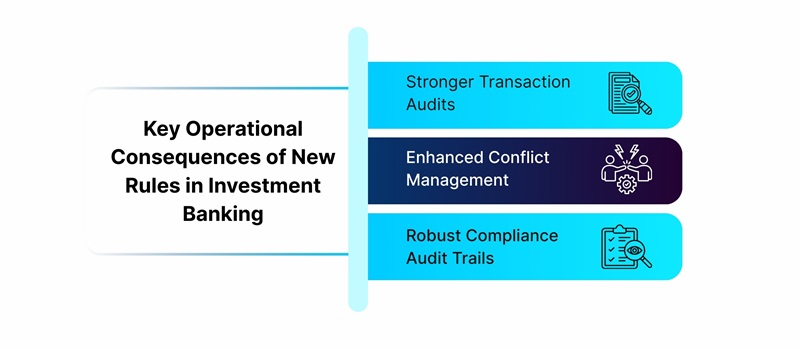
The consequences go to several levels of operations:
-
Greater auditing of transaction materials, particularly where there are risk factors and fee structures that interact.
-
Enhanced accuracy in conflict management, including research interactions and work in capital markets advisory services.
-
Increased requirements on audit trails that show the manner in which compliance judgments were developed.
Impacts on Operations and Internal Controls
New SEC rules transform the front, middle, and back-office organizational structure of institutions. Control functions must confirm that evidence has been provided by operational teams that all steps in the deal cycle can be traced, such as mandate intake through post-closing monitoring.
The execution of the transactions in the investment banking industry has become dependent on stricter pre-deal checks and control points of the workflow tools. Documentation criteria are finer, and valuation of judgment audit trails, committee meeting documents, and client correspondence must be documented.
-
Workflow design is moving towards risk flags, which automatically direct sensitive issues to receive increased review, rather than being ad hoc escalated.
-
Data-handling procedures divide access based on role and minimize abuse of material
non-public information, and enhance monitoring of suspicious activity.
-
The conflict-management processes formalize the reviews of independence, chaperoning policies, and the deal committee sign-offs to ensure that the competing mandates are evaluated uniformly.
Supervisors are under increased pressure to demonstrate the existence of challenges, document rationales of overrides, and ensure that gaps detected in examinations or audits are sealed within agreed timelines. According to a study on 2025 compliance benchmarks presented by BCG, compliance costs of the second line of defense are usually 1.1 to 1.7 percent of total costs incurred by a bank, with the cost of compliance being 2.5 percent. In the case of global systemically important banks, the operating budgets have to be adjusted to the new levels of regulatory compliance.
Compliance Technology and the Push for Automation
The functions of compliance are gradually shifting to systems that have automatic controls compliant with the rules of the SEC. Such tools assist companies in responding more quickly to regulatory changes, minimizing the amount of manual intervention in the high-pressure reporting process, and enhancing the consistency of supervisory records in the investment banking sector. Cleaner trails of documentation are also supported by automation and are increasingly becoming necessary due to growing pressure on the accuracy and timeliness of disclosures by oversight bodies.
The current compliance technology combines compliance checks, workflow triggers, and exception validation into one operational layer. This gives teams a better understanding of the process of decision-making, the location of evidence, and where one may be found wanting. According to a 2025 Moody AI Risk and Compliance Survey, 53% of professionals have adopted or are considering adopting AI-based compliance tools compared to 30% of institutions two years ago, reflecting the adoption rate as firms strive to have better risk control.
Practical priorities for firms include:
-
Developing automated rule libraries that would convert regulatory requirements into alerts and systematic review procedures so that compliance officers can monitor exceptions before they develop into larger issues.
-
Linking data sources by departments to enable the monitoring tools to process both numerical activity and narrative input to enhance the accuracy of the pattern detection and minimize false positives.
-
Creating that allow leveled visibility so that operational teams can see a daily view and senior leadership can see a bigger picture of trending compliance indicators.
-
Conducting simulation exercises to determine the response of automated controls to various SEC regulation scenarios, making sure that any changes are checked before being applied to active workflows.
Strengthening Troubleshooting with Better Monitoring and Governance
Increased accountability under the SEC regulations requires teams that have an understanding of the intent that the controls serve and not view them as procedural impediments. Companies in the investment banking industry are also giving growing focus to organization-wide training, behavioral anticipation, and disciplined escalation processes in such a way that accountability is decentralized among functions.
-
Create role-based training that makes routine tasks related to certain compliance requirements and possible risk exposure.
-
Implement practice based on scenarios that force the team to go through uncertain times rather than wait until a rule is actually broken.
-
Incorporate behavioral requirements within performance conversations in such a way that responsibility becomes part and parcel of daily analysis.
The top management must communicate effectively to inform teams that responsible judgment is what is required and why prompt reporting will protect the company and its customers. Working together with the front office, risk, legal, and operations teams allows challenging assumptions early and sealing internal gaps before they become regulatory problems.
Conclusion
New SEC regulations introduced in 2025 suggest a move toward even greater responsibility, and now companies in the investment banking sector have a better way to build trust with consistent compliance. The early adaptation, the reinforcement of internal processes, and the promotion of confidence in making decisions within teams will be more valuable than ever. The regulations are more stringent but also leave room for enhanced discipline and strengthened control. Moving forward, careful planning will help companies to be steady and responsive as expectations keep rising.