Introduction
Precision, resilience, and prudent risk-taking have long paid off in the capital market. In this challenging environment, female investment bankers are increasingly gaining powerful roles in advisory, underwriting, and strategic deals. Their ascent reflects institutional responsibility backed by quantifiable results. The number of women interested in the profession has been on the rise due to expanded recruitment pipelines and leadership development programs.
Technical expertise, commercial acumen, and sustained visibility in competitive deal teams are all necessary to succeed in this area.
Technical Mastery as a Differentiator for Women in Investment Banking
Promotional debate in major advisory firms often centers on one question: who can perform quantitative analyses on their own and justify each assumption in the presence of a challenging client. Technical authority remains the surest tool to success among women in investment banking. The ability to model discounted cash flows, assess the implications of mergers, design leveraged buyouts, and carry out capital market transactions creates team-cutting credibility. The specialization of sectors also enhances that position. Bankers who exert regulatory subtlety in healthcare, infrastructure finance, or technology dealings are in a better position to receive larger mandates and be exposed to revenue responsibility sooner. According to the Women in the Workplace 2026 study by McKinsey & Company and LeanIn.org, women hold 29 percent of C-suite roles in financial services, reflecting measurable progress tied closely to performance visibility and expertise.
This is supported by certification pathways and further education. Higher qualifications in financial modeling, high accounting skills, and an understanding of cross-border compliance are indications of readiness for complex tasks in investment banking among women who want to be in top positions.
Long-term technical perfection turns execution power into strategic applicability. Top executives always note that women who foresee the risk of downside, clearly describe their capital-structure trade-offs, and manage diligence workstreams in a calm manner, gain access to client origination opportunities sooner and to committee-level discussions.
Sponsorship Capital and Power Networks Among Women Leaders
Closed-door promotion conversation can hardly be based on technical skill only. The promotion to revenue ownership and senior coverage is often based on official endorsement by powerful leaders who are ready to invest in reputational capital. Among female investment bankers, sponsorship acts as an institutional leverage, influencing access to complex mandates, cross-border dealings, and client relationships that form sustained power on the senior level.
Mentorship offers a point of view and developmental feedback, but sponsorship has operational implications. The sponsor promotes the name of a candidate on high-stakes assignments, recommends preparedness in front of compensation committees, and takes risks when it cannot be predicted. A difference of this kind has a significant effect on progression. Formal support can make performance perfect, whereas informal advice can make it refined in a room where the allocation of profit centers and leadership titles is made.
The organized cross-product, industry, and geography alliances frequently occur among senior women leaders in an attempt to amass influence. Positioning is enhanced by exposure to executive committees, regular involvement in high-value deal reviews, and association with profit-generating units. Calibrated network building within the investment banking of women creates quantifiable avenues to origination power and concurrence of partnerships without using informal networks.
Perpetual power networks convert credibility into long-term decision-making authority. Intentional sponsorship, performance discipline, and strategic visibility work in harmony with each other and contribute to progress within institutions where power makes the difference in order as much as technical skill.
Leading Through Institutional Dynamics and Deal-Driven Pressure
The institutional culture can be identified by a live transaction rather than any internal policy document. In such moments, hierarchies are tightened, communication is compressed, and expectations are increased on the spot. As a result, credibility is a product of performance under pressure, particularly in a situation where revenue creation and retaining customers are more important than experience. Investment banking has seen many women establish authority by observable mandate, ownership, rigorous preparation, and repeated presentation in a complex deal cycle. Moreover, influence is also determined by cultural awareness in multinational teams, especially when negotiations cut across regulatory regimes and corporate standards of governance.
Pay negotiation and management placement need to be planned with quantifiable results. Promotion does not often come as a result of informal alignment in isolation; it is a measure of recorded performance, revenue attribution, and strategic assessment. Executive presence is acquired by exposure to many board-level meetings, investor questioning, and negotiating high-stakes situations in which precision and calmness are valued more than technical accuracy.
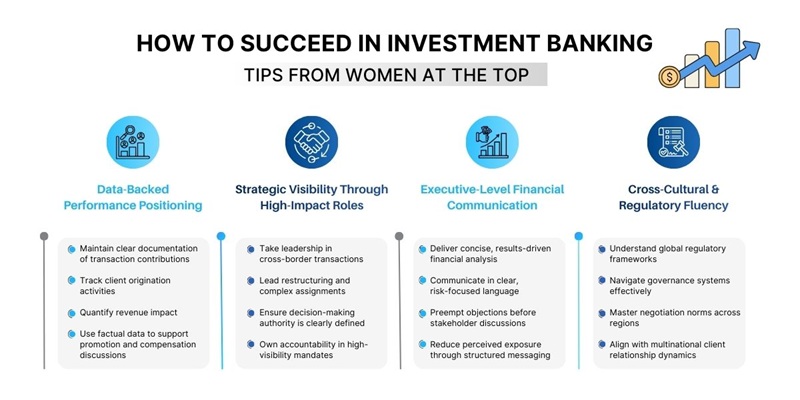
Real-life strategies that have been witnessed among leaders of seniority include:
-
Having clear documentation of transaction contribution, client origination activity, and revenue impact to support promotion and compensation negotiations with factual data, as opposed to vague performance stories.
-
Being proactive in taking leadership positions in high-visibility projects, like cross-border deals or restructuring projects, where the roles of decision-making and responsibility are clearly spelled out.
-
Clarifying the message to senior stakeholders by providing a brief, results-oriented financial analysis, preempting objections and reducing risk exposure in direct terms.
-
Fluency in culture across areas through knowledge of regulatory requirements, negotiation rules, and governance systems that shape the relationships of multinational clients.
The long-term progress of investment banking among women requires transforming high-stress exposure into institutional credibility and long-term strategic power.
Career Sustainability, Leadership Development, and Long-Term Positioning
A deal is closed, a mandate is renewed, and a promotion cycle is initiated. High-finance career survival is seldom dependent on a single deal. In the case of women in investment banking, long-term positioning is defined by the conscious shift between the execution-intensive analyst and associate positions to the revenue ownership and client origination.
Women leaders in their senior positions are more likely to switch to relationship management,
capital-raising strategy, and advisory board-level modelling and structuring. This change broadens the scope of influence beyond the mechanics of transactions to franchise development. Additionally, credibility within the organization also develops when performance is directly associated with quantifiable business contribution, and not just perfect delivery. The longevity path needs a disciplined competence of growth in industries, across geographies, and product lines, so that competency is not out of business as markets turn.
Another thing to note is that, the development of leadership should be done deliberately, as opposed to tenure. Judgment under pressure goes through structured executive education and exposure to new coverage groups through rotations and stretch assignments in complex negotiations. This is the stage where sponsorship determines the outcome. In contrast to mentorship, sponsorship places senior capital behind the advancement dialogues, promotion decisions, and flagship requirements that are at the core of investment banking among women who aspire to be partners or managing directors.
Strategic pacing is also important to career sustainability. The resiliency over the long term can be achieved when professionals project more than a year of objectives, seek adjacent verticals like private capital or corporate strategy, and ensure a visible profile on the initiatives of the firm. Effective expression of ambition, combined with flexibility in market cycles, will place leaders in long-term power, but not on a brief rise to the top.
Conclusion
Women have more than just symbolically made strides in the investment banking field; their progress is structural and quantifiable in the leadership pipelines. The financial institutions are also more likely to tie the accountability frameworks to the goals of representation as a way of reinforcing the commitment over the long term, as opposed to short-term programs. Since the increasing number of companies acknowledge that inclusive decision-making enhances risk assessment and capital allocation, investment banking as a field for women will not only be a channel of personal growth but also a competitive advantage of the entire financial system worldwide.