Introduction
The global funding channels are undergoing structural adjustment due to the shift in cost of capital dynamics by interest rate normalization and regional growth differentials. Capital providers and lenders are tightening credit conditions in certain markets and redistributing to areas where they show robust cash generation. This change is causing corporates to lengthen the time horizon of strategic transactions and seek alternative financing structures that maintain flexibility.
Macro Forces Redefining Global Funding and Deal Activity
The cross-border flows are also becoming more discriminating in nature influenced by the geopolitical pressure and country policy priorities that promote domestic investment. The sovereign and institutional allocations are actively interested in the private credit and structured debt, which forms pockets of liquidity amid compression in the traditional channels. Issuance of equity is also tentatively rebounding in some parts of the world, yet the pricing still favors predictability and financial discipline over high-growth.
Corporate dealmakers are modifying valuation structures to reflect enduring cost uncertainty and regulatory changes. Strategic purchasers are becoming even more focused on acquisitions that provide efficiency in integration, and financial sponsors are focusing on industries that have more distinct monetization opportunities. Such changes affect the speed of transactions and the allocation between small acquisitions and bigger transformational deals.
The latest sentiment metrics indicate that the deal appetite has been more cautious but more focused.
-
Availability of funds is currently dependent on the fundamentals of borrowers and industry strength, which is an indication of a move toward general credit growth.
-
According to 2025 PwC Global M&A Industry Trends Outlook, the volume of deals decreased by 9 percent in H1 2025 and the value of deals grew by 15 percent, which indicates that investors are putting more capital in fewer but higher conviction deals.
Capital allocation decisions are now closely tied to the sophistication of analytical and execution platforms used by market participants. Technology is shaping how funding risks are evaluated, how deals are structured, and how quickly capital can be deployed under shifting market conditions.
Digital Systems and Their Influence on Market Structure
Trading desks are no longer defined solely by speed or scale. The increasing dependence on market infrastructure in digital form is altering the execution of transactions, risk assessment, and data transfer within institutions. This shift has become a defining element of the broader Capital Markets Outlook, as firms recalibrate operating models around software-driven workflows rather than legacy process chains.
Industry firms are increasingly reconfiguring their operations in response to the growing reliance on digital market infrastructure, which now shapes transaction execution, data governance, and risk management. Digital infrastructure is now a differentiator, rather than an operational requirement. The 2025 Digital Transformation & Next-Gen Technology Study confirms that 86 percent of financial services companies have now adopted cloud platforms as part of core operations, which indicates the extent to which operational design in capital markets has been digitized.
Several of these developments are among the most closely observed capital markets trends. The discovery of liquidity is being devolved among venues, and standardized interfaces enable participants to interact more quickly and scale participation without incurring commensurate cost growth. This is also beneficial to risk functions because advanced analytics enhance scenario modeling during volatile conditions.
The adoption trends in the regions vary depending on regulation and the maturity of the market, but the trend is the same. Over time, these structural changes point to longer-horizon trends in capital markets, where competitiveness increasingly reflects data fluency, system resilience, and the ability to adapt operating models without disrupting market continuity.
Shifts in Trading Behavior, Market Microstructure, and Revenue Models
The trading behavior of the capital markets in 2025 shows a change in the interaction between the institutions and liquidity providers to the price discovery, execution, and risk. The market forces have outgrown the pattern recognition to more sophisticated interactions between the trading participants and the technology-based models of execution. The conventional high-frequency trading and liquidity supply is being more informed by real-time indications and algorithmic understanding that react to more subtle market fluctuations. The market microstructure studies have validated that the inefficiencies in price formation and liquidity constraints have a direct impact on execution performance and pricing accuracy, particularly in the emerging markets where structural transparency is inconsistent.
Trading desk and sales channel revenue models indicate these behavioral changes. In the third quarter of 2025, a leading U.S. bank announced that its global markets revenue increased to USD6.2 billion, 11 percent higher than the previous year, and as a result of sales and trading performance.
The Evolution of Equity Market Structure and Trading Behavior
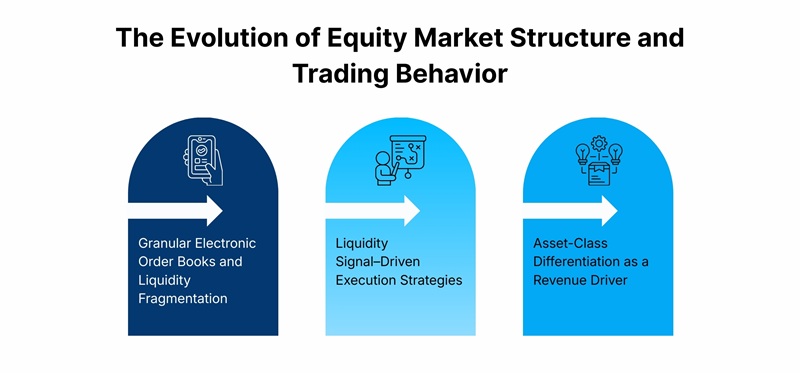
The key outcomes of these changes are:
-
Electronic order books are shaping liquidity fragmentation and participant behavior in equities through more granular limit order book models.
-
The liquidity supply and demand indicators now take a bigger role than just the volume measures, compelling firms to implement adaptive execution strategies.
-
The growth of trading revenues is more associated with asset-class differentiation as opposed to homogenous fee-for-flow models.
Regulatory Momentum and New Standards for Compliance and Reporting
Banking and capital markets are under increased regulatory pressure as authorities progressively raise demand on reporting accuracy, quality of oversight and risk transparency. Supervisors are focusing on the manner in which firms record the decisions, demonstrate model integrity, and have clear audit trails. This change introduces a more rigorous examination of the governance practice, particularly at the intersection of digital systems, automated processes, and high- volume flows of transactions.
Regulators are also repositioning data as a decisive compliance asset. The areas of focus include consistency of reporting, evidence of model validation, anti-financial crime controls, and resilience in operations. It is anticipated that institutions will combine their reporting engines with risk platforms to enable the leadership teams to depend on information that flows in real time rather than in periodic batches.
Some of the practical compliance developments that professionals need to monitor include:
-
Rising reporting frequency and more detailed requirements of transactions.
-
Higher standards for accountability among compliance and risk leaders.
-
Expansion of automated control testing and formalized submission processes.
-
Stronger attention to data lineage and traceability within reporting pipelines.
-
Deeper scrutiny of anti -financial crime systems and their records.
These changes are an indication that companies can no longer view compliance as a limited role. It is emerging as a strategic competency that influences the operating model design, technology choice, and cross border requirements by the institutions. The requirements of quality of data, model governance, and real time monitoring will affect product development, participation in the market, and external relationships. The institutions that are pioneering in their actions can make compliance preparedness a competitive advantage, whereas those that lag can encounter constraints that constrain flexibility at a time when markets are evolving rapidly.
Conclusion
The 2026 Capital Markets Outlook indicates a year that is marked by tighter funding terms, accelerated digital adoption, transformed trading behavior, and heightened regulatory expectations. These changes are an indication of a market environment in which clarity, flexible models, and technology preparedness are important rather than incremental adjustments. As institutions gear up to meet the new trends in capital markets, success will be determined by how well they position their strategy, risk insight, and operational resilience in alignment with structural shifts taking shape across global markets.