Introduction
AI is transforming finance in a way that is compelling professionals to operate more quickly, handle data more accurately, and make decisions using smart systems. Market cycles always change, yet the current shift calls for new strengths built around sharper judgment, stronger data skills, and a more deliberate approach to strategic thinking. Automation is already affecting jobs related to complex transactions, such as investment banking, making it unclear how professions will adapt. Finance departments have shifted their attention to individuals who can operate effectively with sophisticated equipment and remain rooted in the analytical discipline.
Talent Shifts in an Age of Investment Banking Automation
The redefinition of talent appreciation becomes necessary as many of the operational functions are transformed by the automation of investment banking. Routine modeling, data cleaning, and initial valuation processes that characterized early careers are now done more effectively with automated workflows. Human roles move toward deeper analysis, clear judgment, and strategic contribution. Professionals who strengthen their ability to assess information, communicate effectively, and guide oversight will play a more influential part in shaping future success in banking.
-
The ability of junior investment banking analysts and associates in coverage groups, M&A verticals, and capital markets teams to combine financial understanding with expertise in data fluency and accurate communication is an advantage. The standardized work is done by automation, and these professionals are focused on forming insight, questioning model assumptions, and creating stories that inform senior deliberations.
-
Analysts and associates who have knowledge of compliance, regulation, reporting, and ethical reviewing procedures are essential. The automation has the capability of hastening the documentation, but intricate transactions, cross-border controls, and risk sign-offs require human appraisal and responsibility.
Stay informed with industry insights, updates, and
exclusive content from IBCA.
Subscribe Now
What AI’s Rise Signals for Everyday Investment Banking Tasks
AI will transform most of the jobs that previously had to be done manually; the routine work of analysts, associates, and operations personnel will change in meaningful ways. Previous manual data collection, preliminary valuations, pitch books, and standard reports are becoming automated. The human roles will be changed to supervision, interpretation, interaction with clients, and strategic thinking.
-
AI systems are currently used in most middle-office and back-office processes to collect, reconcile, and detect anomalies in data. These systems can process thousands of transactions or footnotes in minutes. This will minimize the number of errors that are associated with manual data entry and allow the staff to concentrate on exceptions and complex cases.
-
Front-office support jobs like preparing first-time financial models, creating standard investor decks, or summarizing public filings are being given over to AI-powered software. That would save time without compromising quality. Employees continue to interpret outcomes, stress-test assumptions, and create stories for clients.
-
Internal audit routines, compliance, and documentation are also changing. Artificial intelligence identifies anomalies, generates audit trails, and implements template standards, thereby offloading low-value work from compliance staff and enabling them to focus on judgment, regulatory strategy, and governance.
According to a 2025 survey by the Gartner Finance Practice, 59 percent of finance leaders said that they have been actively using AI in their finance functions. This change is indicative of a wider acceptance of automated assistance in modeling, review processes, and compliance reviews. It also demonstrates the extent to which teams are turning to AI to balance the workloads, shorten turnaround durations, and shift focus to decisions that require market or customer priorities.
Advanced Skill Paths for an AI-Integrated Finance Career
The skills in analytics will no longer be a source of employment security. The 2025 research of the World Economic Forum released recently shows that 32-39 percent of tasks in capital markets, insurance, and other financial services are now possible to be carried out by AI-enabled tools. That is what makes technical fluency significant, though not enough. The professionals who will shine through are those who come to the table with business knowledge, risk management, ethical decision-making, and real-life experience.
-
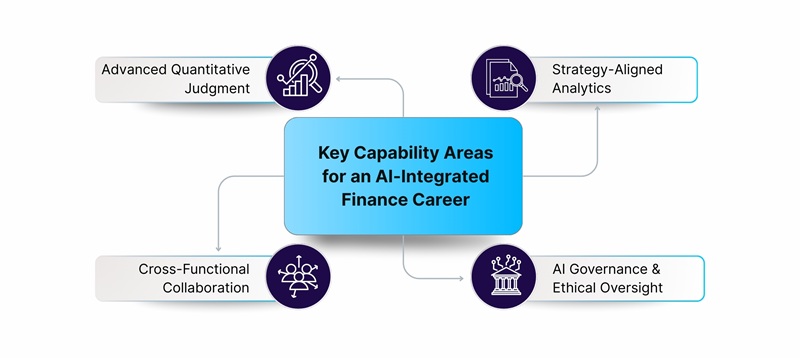
Enhancing quantitative analysis and critical assessment, such as the ability to interpret complex model outputs, identify anomalies, and know when human supervision is required to make an accurate forecast and risk assessment.
-
Connecting analytical findings with business strategy, in which professionals perceive data through the lens of regulation, client goals, market forces, and long-term positioning, allows insights to be converted into action that is consistent with business objectives.
-
Developing cross-functional communication and collaboration to allow easier coordination of modeling teams, regulatory teams, operations, and customer-oriented functions to assist in quicker decisions and more precise alignment.
-
Applying governance and ethical judgment in AI use, including responding to data privacy, bias, transparency expectations, and compliance needs, to ensure that automated processes are also honest and trustworthy for clients
Strategic Use of AI in Investment Banking for Better Decision Cycles
The strategic application of AI to investment banking changes the decision cycles from being periodic and reactive to continuous and insight-driven. Deal teams are able to query much larger data sets, model scenarios, and bring to light signals that would not have been visible in manual models. Final decisions remain in the hands of human judgment, but AI assists in organizing the information in such a way that trade-offs, risk exposures, and implications of a client are more evident and easier to evaluate. The Investment Banking Industry Survey Report 2025 by SG Analytics states that 66 percent of companies are hastening investment in AI and machine learning in order to enhance the quality of decisions and operational efficiency.
Investment banking automation is most beneficial to finance leaders when it is combined with judgment-intensive activities, such as:
-
Ranking prospects, indicating warm relationships, and reordering priorities as markets change with dynamic origination support that allows bankers to spend their time where conversion odds are greatest, rather than sorting through stagnant lists.
-
Real-time risk and scenario engines that stress test structures based on rates, spreads, liquidity terms and conditions, and counterparty behavior, and provide a better picture to committees before agreeing on terms or intensifying problems.
-
Client-facing analytics that can make complex recommendations understandable and easy to follow, and that build trust when some stakeholders remain concerned that AI will replace investment banking or just amplify the human advisory experience.
Leadership Priorities for Guiding AI-Driven Finance Teams
AI-based financial leadership begins with purpose and strong boundaries. The executives determine how the use of AI in investment banking helps achieve client outcomes, risk appetite, and regulation, and translate that into rules that apply to the work of teams. The change of talent strategy focuses on hybrid functions, which are a combination of financial judgment, data skills, and model oversight, and culture compensates for experimentation supported by disciplined testing and documentation.
-
Establish official control of investment banking automation, such as decision authority, escalation, and independent model validation, such that bankers use the output of AI models rather than develop simultaneous manual workarounds.
- Invest in organized educational initiatives that will align senior bankers with data experts in a way that makes it clear to them what would be automated by the artificial intelligence in terms of repetitive tasks and where the human signature, ethical conduct, and relationship management would be at the center.
Conclusion
The way ahead lies in the understanding that human insight is a core part, despite the increased sophistication of automation. The ability to adapt to new tools, challenge assumptions, and sharpen judgment produces stronger results by professionals who are working in an environment shaped by investment banking automation. The future of work is a combination of technical fluency and strategic thinking, particularly as companies incorporate AI in the field of investment banking and determine what AI will replace investment banking with in long-term investment banking positions. Remaining interested, nimble, and ready keeps careers on the move.