Asset management is changing as investors seek suitable products, clear reporting, transparent fees, and convenient access to information. At the same time, managers are responding to stronger competition, growing interest in private markets, advances in technology, and increased regulatory expectations.
These developments are changing how firms research investments, construct portfolios, communicate with clients, and control risk. Long-term success will depend on combining sound investment judgement with reliable operations, responsible innovation, and a clear understanding of each investor’s financial objectives.
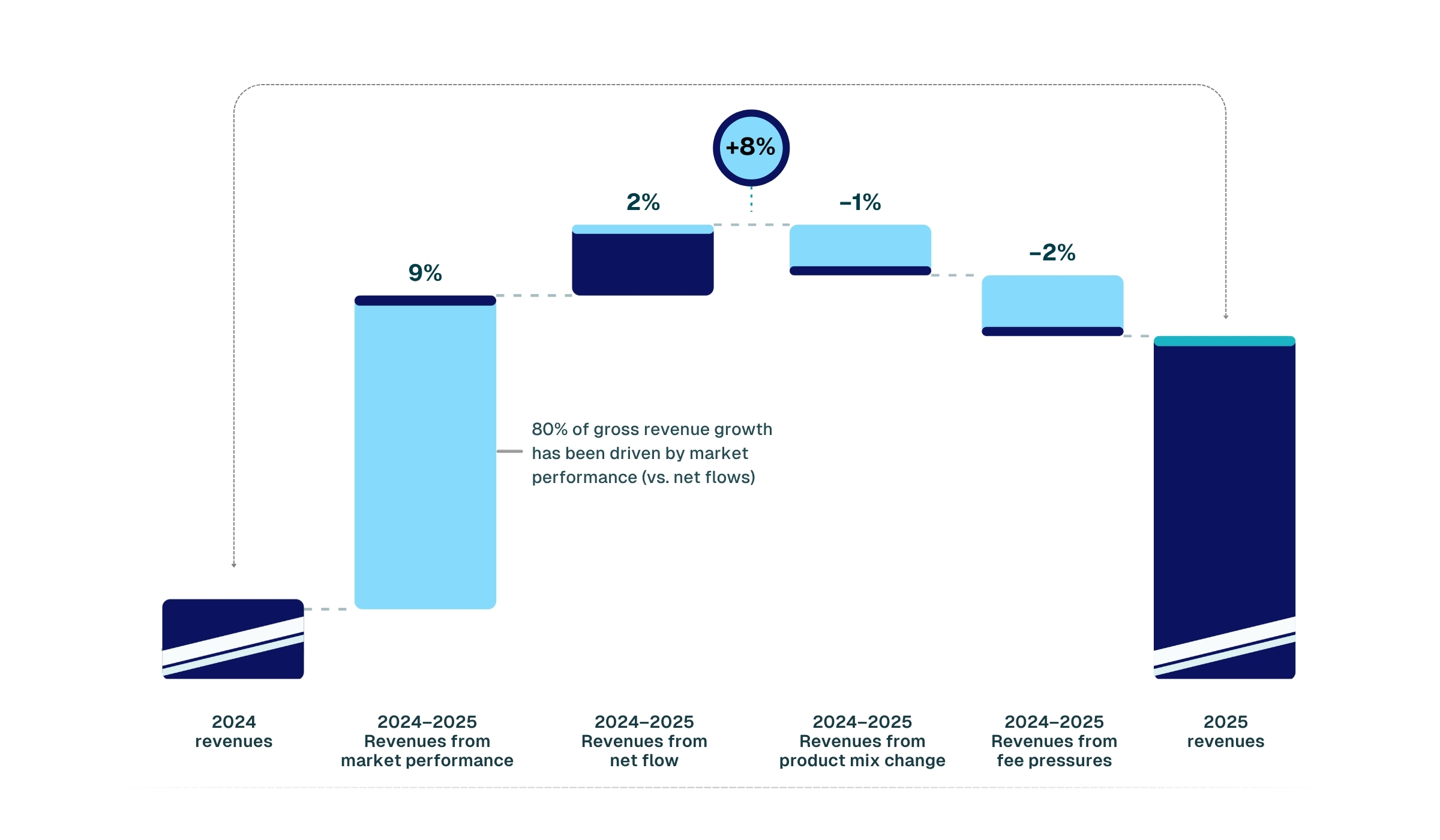
Source: Boston Consulting Group (BCG), Global Asset Management Report 2026: An Imperative for Growth, 2026
The BCG image shows the relationship between total assets under management and the sources of industry growth. Global assets under management reached USD 147 trillion in 2025, representing an 11% increase from the previous year. However, more than 80% of gross revenue growth came from market appreciation, while a smaller share resulted from new investor money entering the industry.
The Meaning of Financial Asset Management
Financial asset management is the professional process of selecting, monitoring and adjusting investments to help individuals and institutions meet defined financial objectives. It may involve shares, bonds, cash instruments, investment funds, real estate securities, and private market assets.
Financial assets can include:
- Company shares and other equities
- Exchange-traded funds and mutual funds
- Government and corporate bonds
- Real estate investment funds
- Private equity and private credit
- Infrastructure and other alternative investments
Trends Shaping the Future of Asset Management
The industry is being influenced by changing investor behavior, product competition, private market fundraising, and improved digital services. These developments are affecting how managers attract capital and deliver their services.
- Retail Participation is Increasing
Retail investors accounted for 61% of global AUM growth between 2020 and 2025, according to the Boston Consulting Group.
This shift changes how investment products are designed and distributed. Retail investors generally expect clear information, accessible digital services and transparent charges. Asset managers that have traditionally focused on institutional clients may need to improve online communication, simplify product explanations, and offer investment solutions that can be understood without specialist knowledge.
A fund with a complicated structure may be difficult to distribute to retail investors, even when its investment strategy is sound. Managers therefore need clear documentation, suitable digital interfaces, and communication that avoids unnecessary technical language.
- Passive Investment Remains Competitive
Passive funds generally follow an index or a defined market segment. They can provide broad diversification and relatively low operating costs. Exchange-traded funds also offer intraday trading, although their market price may differ slightly from the underlying value of the assets.
Active management continues to have a role where research and flexibility may improve results. Examples include less efficient bond markets, smaller companies, and portfolios that require careful management of credit or liquidity risks. The relevant comparison is the expected result after fees and risk.
- Private Markets Require Careful Selection
Private markets include private equity, private credit, infrastructure, and private real estate. These investments may provide diversification and access to companies or projects that are unavailable through public exchanges.
Private investments also have important limitations. Valuations may be based on periodic assessments rather than daily market prices. Investors may face lock-up periods, capital calls, and delays when selling an interest.
- Technology, Data and Investment Decisions
Digital systems now support research, portfolio monitoring, trade processing, client reporting, and compliance. Their usefulness depends on accurate information and clear responsibility for decisions.
- Artificial Intelligence in Asset Management
Artificial intelligence can help analysts review company filings, compare financial data, and identify changes across large portfolios. It can also assist with report preparation, document searches, and routine customer enquiries.
The technology should support professional judgement rather than replace it. For instance, a research team may use a system to compare hundreds of company filings. An analyst must still confirm the information, assess its importance, and decide whether it affects the investment thesis.
- Tokenized Investment Products
Tokenization records ownership digitally, potentially improving transfer efficiency, supporting fractional ownership, and shortening settlement processes, subject to regulatory and operational factors.
PwC expects tokenized fund assets under management to increase from USD 90 billion in 2024 to USD 715 billion by 2030. The forecast represents a compound annual growth rate of 41%.
- Data Quality and Security
Reliable data is essential for valuation, risk measurement, and regulatory reporting. Asset managers should maintain controls for:
- Data access and ownership
- Cybersecurity and privacy
- Model testing and documentation
- Price and exposure verification
- Human review of automated outputs
A system that processes information quickly still produces unreliable results when the underlying records are incomplete or incorrectly classified.
Strategies for Long-Term Resilience
Strong performance alone may not protect an asset management business from changing investor preferences. Managers also need an efficient operating model, clear product design, and a reliable risk process.
- Start with the Investor’s Objective
Portfolio construction should begin with the purpose of the investment. A pension scheme may focus on matching future liabilities. A family office may prioritize capital preservation. A retail investor may need regular income and easy access to savings.
The review should consider:
- Expected return and acceptable loss
- Investment period
- Cash requirements
- Currency and geographical exposure
- Tax and regulatory conditions
This helps avoid choosing products solely based on current popularity.
- Review Active and Passive Exposure
Passive products may provide efficient market exposure at a lower cost. Active strategies may be appropriate when managers have a clear research advantage or need flexibility in security selection.
A higher-cost fund should have a well-defined process and a reasonable basis for delivering value after fees. Asset managers must review performance over an appropriate period and compare it with a relevant benchmark.
- Manage Costs Across the Business
Profitability is under pressure across the sector. Cost reviews should cover technology, administration, custody, distribution, staffing, and compliance. It is important to identify repeated processes and systems that do not contribute to better service, stronger controls, or improved investment decisions.
- Strengthen Risk Oversight
A complete risk framework should cover market, credit, liquidity, operational, cyber, and model risks. Stress testing can show how a portfolio may respond to higher interest rates, falling equity markets, borrower defaults or delayed private asset sales.
For example, a private credit manager should examine borrower quality, collateral, repayment schedules, industry concentration, and possible recovery values. The stated yield does not provide a complete assessment of the investment.
- Improve Client Segmentation
Institutional and retail investors require different levels of information. An institutional client may need detailed exposure reports, liability analysis, and regulatory documentation. A retail client may need a clear explanation of fees, risk, and withdrawal conditions.
Personalized recommendations should be based on accurate client information and suitability assessments. Digital tools should make the reasoning behind a recommendation easier to understand.
Sustainability and Regulation
Sustainability considerations are now part of research, risk assessment, and product reporting. Their use must be specific, documented, and connected to the investment process.
A manager may review a company’s emissions, workforce practices, board structure, and exposure to environmental regulation. The analysis should explain how those matters may affect revenue, operating costs, access to finance, or valuation.
For example, two energy companies may face different financial risks because one has detailed transition plans and reliable reporting, while the other has greater exposure to regulatory changes and limited disclosure.
- Prepare for Closer Examination
Regulators and investors in major markets are placing greater emphasis on sustainability claims, product disclosures, valuation methodologies, automated systems, and investor protection. Asset managers must maintain records showing how investment decisions are made and monitored.
Compliance teams should participate when a new fund, reporting system, or automated recommendation process is designed. Early review can reduce the risk of unclear disclosures and unsuitable products.
A Practical Framework for Implementing Asset Management Strategies
This section explains how asset managers can turn future-focused priorities, such as technology adoption, portfolio improvement, cost control, and stronger risk oversight into practical business actions.
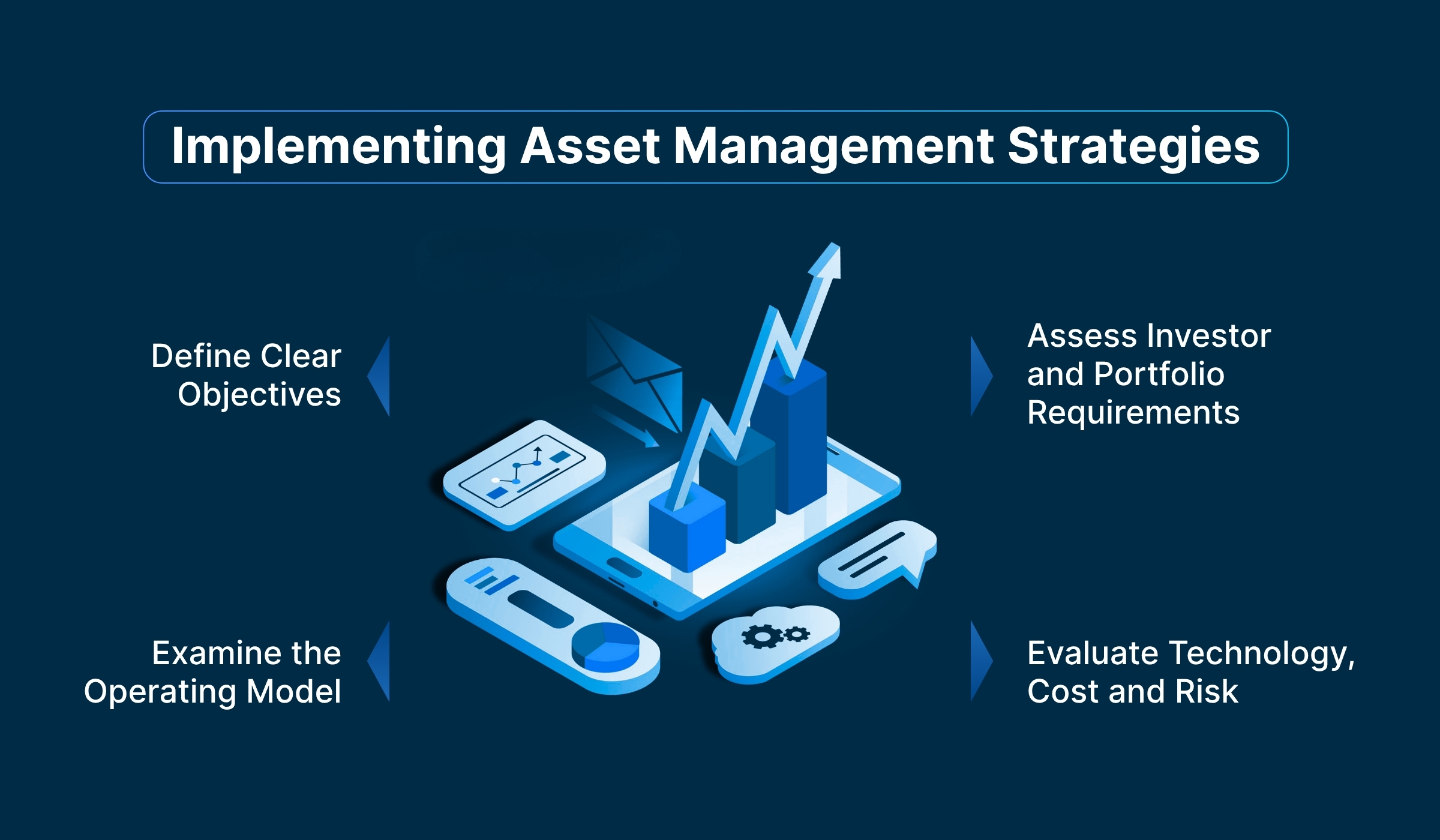
Possible objectives include increasing net inflows, reducing processing errors, improving reporting accuracy, or lowering operating costs. Each objective should have a responsible owner and a review date.
- Assess Investor and Portfolio Requirements
The next step is to examine the needs of the investors who will be affected. Institutional investors may require detailed exposure reports, liability analysis, and regulatory documentation. Retail investors may place greater importance on simple explanations, transparent fees, and convenient access to account information.
The assessment should also consider:
- Investment objectives
- Risk tolerance
- Liquidity requirements
- Investment horizons
- Tax and regulatory considerations
- Existing portfolio exposure
This review prevents managers from introducing a product or system that is technically advanced but unsuitable for the intended users.
- Examine the Operating Model
The review should identify manual, duplicated, or unreliable processes across research, trading, valuation, reporting, and customer service. Managers can then determine which activities require new systems and which require better procedures.
- Evaluate Technology, Cost and Risk
Before adopting a new platform or automated tool, the manager should assess its practical value. The review should cover purchase and maintenance costs, data security, compatibility with existing systems, staff requirements, and regulatory obligations.
For systems using artificial intelligence, the assessment should also consider:
- How does the system produce its results
- Whether the information can be checked
- How confidential data is protected
- Who approves the output
- What happens when the system produces an error
- How will the model be monitored over time.
Conclusion
The asset management industry is moving towards broader product choice, greater use of technology, stronger private market participation, and closer regulatory review. Firms that maintain accurate data, design products around investor needs, control operating costs and document their decisions will be better placed to manage changing market conditions.