An equity strategist analyzes broad market trends and integrates economic,
corporate, and market data to develop detailed investment perspectives. The
role focuses on sectors, market indexes, regions, investment styles, and risk
in addition to individual companies.
A strategist may advise increasing exposure to technology stocks, reducing
exposure to small companies or favoring value stocks over growth stocks.
These views help portfolio managers, institutional investors, sales teams,
and clients make better allocation decisions.
The equity strategists connect the overall economic picture with decisions
about stocks. Their work integrates financial analysis, economic research,
valuation, portfolio construction, and concise communication.
Equity Strategist vs Equity Research Analyst
The difference is mainly the level of focus. An equity research analyst
usually studies individual companies or a specific industry. An equity
strategist studies relationships across the wider market and explains how
economic conditions may affect groups of stocks.
|
Role
|
Main Focus
|
Typical Output
|
|
Equity Research Analyst
|
Individual companies and industries
|
Company reports, earnings estimates, and stock recommendations
|
|
Equity Strategist
|
Sectors, indexes, regions, and investment styles
|
Market outlooks, sector views, and allocation recommendations
|
The roles work together. For example, a company analyst may find that a
manufacturer has strong earnings growth. The strategist then considers
whether higher interest rates, weaker demand, or a broader shift away from
cyclical stocks could affect the entire industry. The equity strategist helps
connect that industry view with the portfolio manager’s decision about how
much capital to allocate.
Core Responsibilities of an Equity Strategist
The responsibilities vary by employer, although the central purpose remains
consistent, as they develop a well-supported view of the market and explain
what it means for investors.
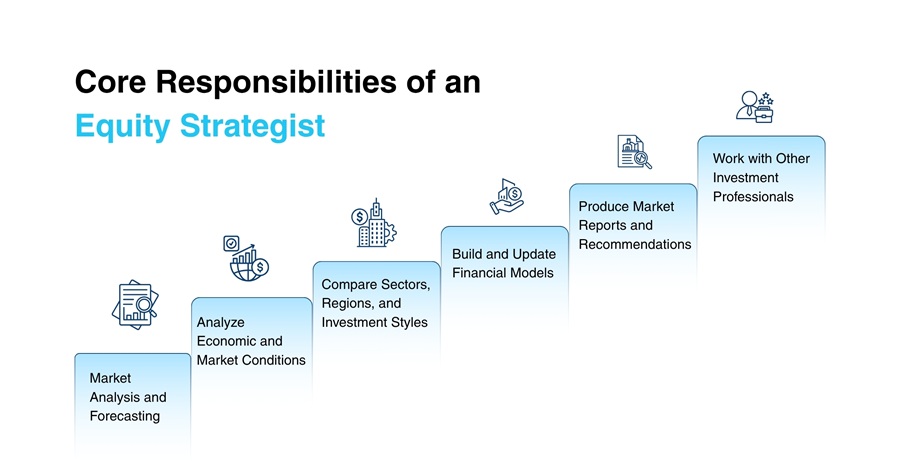
- Market Analysis and Forecasting
These professionals spend a large portion of their day studying broad market
trends. They use equity research to examine macroeconomic data like inflation
rates, interest rates, and gross domestic product (GDP) growth. For example,
if a country reports higher-than-expected inflation, the strategist will
analyze how this might reduce consumer spending. They will then forecast how
this reduction will affect retail stocks. They review historical market
cycles to find similarities with current events.
According to a January 2026 report from the
Bureau of Labor Statistics, accurate inflation forecasting remains the top priority for financial
institutions this year. By combining this data, they build models to predict
market movements over the next six to twelve months. They present these
forecasts to help clients prepare for upcoming economic shifts.
- Analyze Economic and Market Conditions
A strategist monitors interest rates, inflation, employment, economic growth,
currencies, government policy, and geopolitical events. These factors can
change the expected performance of different sectors.
For example, rising interest rates may increase financing costs for companies
and reduce the present value of future earnings. A strategist may therefore
review whether high-growth technology stocks are becoming less attractive
compared with established companies that generate steady cash flow.
This work is part of equity strategy research, because the strategist
evaluates how economic conditions influence stock market behavior and
investment risk.
- Compare Sectors, Regions, and Investment Styles
Strategists compare sectors such as financial services, healthcare, energy,
and consumer goods. They may also compare large-cap and small-cap stocks,
developed and emerging markets, or growth and value strategies.
The comparison is based on factors such as earnings growth, valuation, profit
margins, balance sheet strength, market momentum, and sensitivity to economic
changes. The objective is to identify where expected returns may justify the
risks.
For instance, if manufacturing activity is improving while commodity prices
remain stable, a strategist may study whether industrial companies could
perform better than defensive sectors. That view would require company-level
evidence from analysts as well as a broader assessment of demand and market
pricing.
- Build and Update Financial Models
Strategists use spreadsheets and financial models to test different market
scenarios. A model may estimate how changes in interest rates, earnings
growth, or profit margins could affect an index or sector.
The model does not predict the future with certainty. It shows how an
investment view changes when important assumptions change. This helps
investors understand both the potential opportunity and the downside risk.
- Produce Market Reports and Recommendations
A strategist may publish a daily market note, a weekly sector review, a
quarterly outlook, or a detailed thematic report. These reports normally
explain the main market trend, the evidence supporting it, the risks to the
view, and the action investors may consider.
Recommendations can include:
- Increasing or reducing exposure to a sector
- Favoring one region over another
- Choosing large-cap or small-cap stocks
- Preferring value or growth investments
- Adjusting exposure to market risk
Reports must be clear because the audience may include portfolio managers,
sales teams, corporate executives, and clients with different levels of
technical knowledge.
- Work with Other Investment Professionals
An equity strategist rarely works alone. The role requires regular
interaction with company analysts, economists, quantitative researchers,
portfolio managers, traders, and client teams.
A strategist may combine economic forecasts from an economist, earnings
estimates from an analyst, market data from a quantitative team, and
portfolio constraints from a fund manager. The final recommendation should
explain how these different inputs support one conclusion.
Why Equity Strategy Research Matters to Investors
Equity strategy research synthesizes company-level data into comprehensive
portfolio decisions. A strong company may still face pressure if its entire
industry is losing demand. Similarly, a company with average growth may
benefit from a favorable sector trend or strong market conditions.
The role is especially important when market conditions are changing quickly.
Securities Industry and Financial Markets Association (SIFMA)
reported that U.S. equity average daily volume reached 20.0 billion shares in
the first quarter of 2026, up 27.3% from a year earlier. The report also
recorded total U.S. equity capital formation of USD 58.8 billion during the
quarter. These figures show the scale and activity of the market that
strategists monitor.
A strategist also considers market structure, and investor protection. In
January 2026, the
U.S. Securities and Exchange Commission
explained that current rules address conflicts involving equity research and
are designed to protect the independence of published analysis.
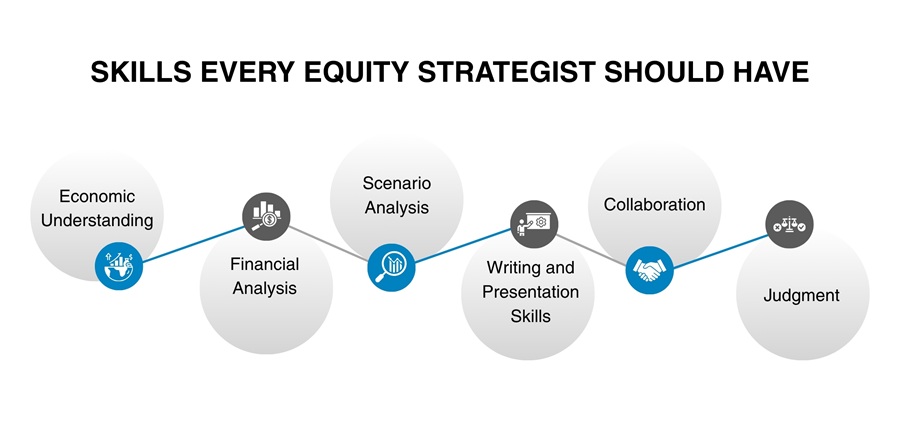
Skills Required for the Equity Strategist Role
Successful strategists need a combination of analytical and communication
skills.
-
Economic Understanding: The ability to interpret interest rates,
inflation, growth, and public policy.
-
Financial Analysis: The ability to read financial statements,
compare valuations, and assess earnings trends.
-
Scenario Analysis: The ability to test how different assumptions
may affect sectors and indexes.
-
Writing and Presentation Skills: The ability to explain a complex
view in clear language.
-
Collaboration: The ability to combine research from several teams.
-
Judgment: The ability to weigh evidence and identify the risks to
an investment view.
These skills are developed through company analysis, portfolio work,
economics, and market observation. Equity research can provide a strong
foundation because it teaches professionals how businesses operate, compete,
grow, and create value.
How to Become an Equity Strategist
Most professionals enter the field after gaining experience in equity
research, investment analysis, economics, portfolio management, or trading. A
degree in finance, economics, accounting, mathematics, or a related subject
is common. Some employers also prefer candidates with a Master of Business
Administration or other advanced qualifications in finance or investment
management.
Employers typically look for candidates who can analyze markets, develop
investment strategies, support portfolio decisions, and communicate complex
financial insights clearly. Experience requirements vary depending on the
organization and the scope of the role.
An aspiring strategist should learn to write research notes, build financial
models, follow economic data, and defend an investment view with evidence.
Experience in equity strategy research is valuable because it develops the
ability to connect company fundamentals with market-wide decisions.
Conclusion
An equity strategist analyzes more than simple market direction. The
professional studies economic conditions, company results, valuation, market
behavior, and investor expectations to determine how different parts of the
equity market may perform.
The most useful output is a clear decision framework. It explains what is
changing, which assets may be affected, why the view is reasonable, and what
could prove it wrong. That combination of research, judgment, and
communication allows strategists to support portfolio decisions in a
disciplined way.