The industrials investment banking sector drives the global economy by managing capital raises and mergers and acquisitions for large manufacturing companies. The first quarter of 2026 showed that the global industrial market remained resilient, reaching an estimated value of USD 15.6 trillion, according to the Spring 2026 M&A report.
This financial sector focuses on companies that build heavy machinery, aerospace components, automotive parts, and defense systems. Bankers in this field evaluate complex supply chains and massive capital expenditures to determine accurate company valuations.
This comprehensive guide explains the core functions, key drivers, and financial mechanics that define the industry. Gain a clear understanding of how professionals execute these transactions and navigate current market conditions.
Core Functions of the Industry
Understanding the foundation of this financial sector requires looking at the specific services banks provide to large corporate clients.
- Capital Raising Strategies
Investment banks help industrial companies raise funds to build new factories or upgrade equipment. They issue stocks or bonds to investors who want to fund these large projects.
For example, a commercial airline manufacturer might issue corporate bonds to finance the development of a new aircraft model. This financing provides the company with capital to support long-term projects.
- Strategic Advisory Services
Bankers provide expert advice to corporate boards regarding future business decisions. They analyze market trends and recommend whether a company should expand into new regions or sell off unprofitable divisions.
For example, an advisory team might suggest that a heavy machinery builder sells its consumer tools division to focus purely on commercial equipment. This guidance helps companies remain profitable in competitive markets.
- Corporate Restructuring Operations
When industrial companies face financial difficulties, bankers step in to reorganize their debts and operations. They negotiate with lenders to lower interest rates or extend payment deadlines.
A recent example involves automotive parts of suppliers restructuring their debts to survive supply chain disruptions. This intervention prevents bankruptcies and saves thousands of manufacturing jobs.
Industrial businesses require significant debt financing to operate their capital-intensive facilities. Bankers structure loans that match the lifespan of the equipment being purchased.
If a company purchases a fleet of transport ships with a long useful life, bankers may help structure or arrange long-term financing that aligns the debt profile with the company’s expected cash flows and asset life.
- Leveraged Buyout Executions
Private equity firms frequently use borrowed capital to purchase industrial companies. Bankers arrange leveraged buyouts by securing loans collateralized by the target company’s assets.
For example, a private equity firm might acquire a packaging manufacturer, using the factory’s equipment as collateral for a bank loan. This strategy allows investors to buy large companies with minimal upfront cash.
The Role of Diversified Industrials Investment Banking
A broad approach enables financial institutions to handle large companies that operate across multiple industries simultaneously.
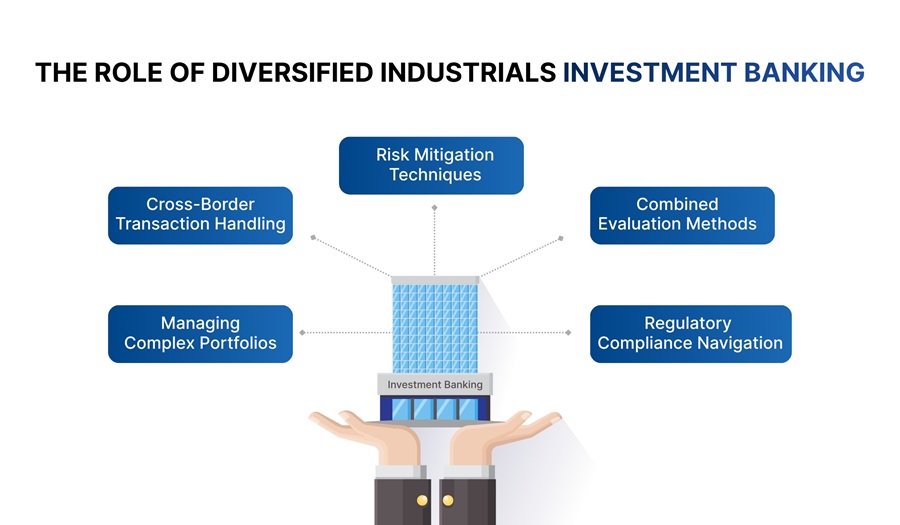
- Managing Complex Portfolios
A major segment is diversified industrials investment banking, which deals with corporations producing everything from lightbulbs to jet engines. Bankers must value each division separately and combine them to understand the total company’s worth.
For example, General Electric historically required complex portfolio management because it operated in healthcare, aviation, and energy simultaneously. Bankers measured such conglomerates using sum-of-the-parts valuations.
Following GE’s multi-year restructuring, those businesses now operate as three standalone companies: GE HealthCare (GEHC), GE Aerospace (GE), and GE Vernova (GEV). Each is now separately listed and valued in the public markets rather than as divisions within a single parent company.
- Cross-Border Transaction Handling
Large industrial conglomerates usually operate factories in multiple countries. Bankers coordinate deals that cross international borders and involve different currencies and legal systems.
If a German automotive company buys a Mexican parts supplier, the banking team manages the currency exchange rates and regulatory approvals in both nations. This global coordination ensures smooth ownership transitions.
- Risk Mitigation Techniques
Industrial companies face severe risks from fluctuating raw material prices and currency changes. Banker’s design financial contracts called derivatives to protect companies from these price swings.
For example, a bank might enter into a contract that locks in the price of steel for a construction equipment manufacturer for 2 full years. This protection helps the manufacturer accurately predict future building costs.
- Combined Evaluation Methods
When two large conglomerates merge, bankers estimate the cost savings from combining their operations. They look for duplicate departments like human resources or shipping routes that can be eliminated.
Success in diversified industrials investment banking relies on correctly identifying these cost efficiencies. Accurate synergy estimates convince shareholders to approve massive corporate mergers.
- Regulatory Compliance Navigation
Governments heavily regulate industrial sectors for environmental and national security reasons. Bankers must ensure that any proposed transaction complies with all local and international laws.
If a foreign company tries to buy a domestic defense contractor, bankers navigate the strict government approval processes. This legal diligence prevents costly deal cancellations and government fines.
Key Drivers of Industrials M&A
Market forces and technological advancements consistently push industrial companies to merge with or acquire their competitors.
- Supply Chain Consolidation
Recent industrial M&A transactions show a trend of companies buying their suppliers to prevent production delays. Manufacturers want total control over the materials they need to build their products. For example, an electric vehicle manufacturer might acquire a lithium mining company to guarantee a steady supply of battery materials. This vertical integration reduces the risk of factory shutdowns.
- Technological Integration
Traditional manufacturing companies often acquire technology startups to modernize their factories. They acquire robotics firms or software developers to automate their production lines. For instance, a warehouse equipment builder may acquire an artificial intelligence company to develop self-driving forklifts. These technology acquisitions help older industrial companies remain relevant and efficient.
Companies often use acquisitions to enter new geographic markets fast. Buying an established foreign company provides immediate access to local factories, workers, and customers. If a United States tractor manufacturer wants to sell products in Europe, acquiring a French agricultural machinery brand is faster than building new factories from scratch. This strategy facilitates faster access to international markets and potential revenue expansion.
- Cost Reduction Initiatives
Executing successful industrial M&A requires a sharp focus on reducing operational expenses. Two competing companies might merge to achieve economies of scale and lower their production costs. By combining their purchasing power, the new, larger company can negotiate lower prices for raw materials such as aluminium and copper. These cost reductions directly increase the combined business’s overall profit margins.
- Environmental Standard Adaptations
Stricter global environmental regulations force industrial companies to acquire green technology providers. Manufacturers must lower their carbon emissions to avoid heavy government penalties. An oil refinery equipment builder might acquire a carbon capture technology firm to offer cleaner solutions to its clients. These strategic purchases can support long-term competitiveness in a highly regulated global economy.
Valuation Methods in Industrials Investment Banking
Accurately pricing heavy manufacturing and capital-intensive businesses requires specific financial modeling techniques and deep industry knowledge.
Industrial companies own massive physical assets, such as factories, warehouses, and heavy machinery. Bankers rely heavily on discounted cash flow analysis to predict how much these assets will generate over the next decade. They must factor in the high costs of maintaining and eventually replacing this aging equipment. A company that fails to update its machinery will see its value drop significantly in the financial models.
Another common method involves comparing the target company to similar publicly traded businesses. Bankers look at the Enterprise Value to Earnings Before Interest, Taxes, Depreciation, and Amortization multiple. Because industrial companies incur significant depreciation expenses on their heavy machinery, this multiple provides a clearer picture of their true cash flow.
Bankers create detailed valuation tables illustrating hypothetical valuation multiples across industrial sub-sectors.
| Industrial Sub-Sector | Average EV/EBITDA Multiple | Primary Value Driver | Typical Capital Expenditure Level |
| Aerospace and Defense | 12.5x | Government Contracts | High |
| Building Products | 8.2x | Housing Market Growth | Medium |
| Industrial Machinery | 10.4x | Factory Automation | High |
| Packaging Materials | 7.9x | Consumer Goods Volume | Low |
| Transportation Logistics | 9.1x | Global Trade Volumes | High |
This table demonstrates that aerospace companies command higher valuations due to the stability of long-term government contracts. Packaging companies trade at lower multiples because they face intense pricing competition and lower profit margins.
Recent Trends Shaping the Market
The landscape of industrial finance keeps shifting in response to global economic changes and emerging production technologies.
The industrial sector experienced significant growth driven by resilient domestic demand and infrastructure spending. According to official data released by the Ministry of Statistics and Programme Implementation, industrial growth reached a remarkable 7.3% in June 2026.
This surge was fueled by strong performance in the manufacturing, electricity, and capital goods sectors. Bankers actively monitor these production indexes because high factory output typically leads to increased merger and acquisition activity.
Furthermore, companies continue to localize their supply chains to avoid international shipping delays. This reshoring trend requires massive investments in domestic manufacturing facilities. Investment banks provide essential financing for local factory construction. As long as companies prioritize supply chain security, the demand for industrial financial services will remain exceptionally high.
Conclusion
The industrial sector remains the physical backbone of the global economy. Investment banks provide the critical financial architecture that allows manufacturing and infrastructure companies to grow, adapt, and survive. From executing complex leveraged buyouts to advising cross-border acquisitions, bankers handle the complex mathematics of heavy industry.
Ongoing demand for automation and supply chain security will sustain sector growth. Professionals who understand physical-asset valuation, capital-intensive businesses, and global trade dynamics are well positioned to navigate the evolving industrial investment-banking landscape.