Decisions in the investment sector are mostly driven by the pursuit of returns, long-term growth, and clearly defined financial goals. Still, there is a degree of uncertainty in every possible benefit. It is this uncertainty that we refer to as risk, and being able to handle it is the key to smart investing. Portfolio risk management includes tracking potential threats, and actively managing their impact on overall portfolio performance.
No matter if you’re a single investor or managing funds, you can’t ignore risk. It could end up costing you money. Understanding and managing risk empowers investors to make informed decisions, optimize returns, and stay aligned with long-term financial targets. The goal is not to eliminate risk entirely, but to manage it in line with individual comfort levels and investment objectives.
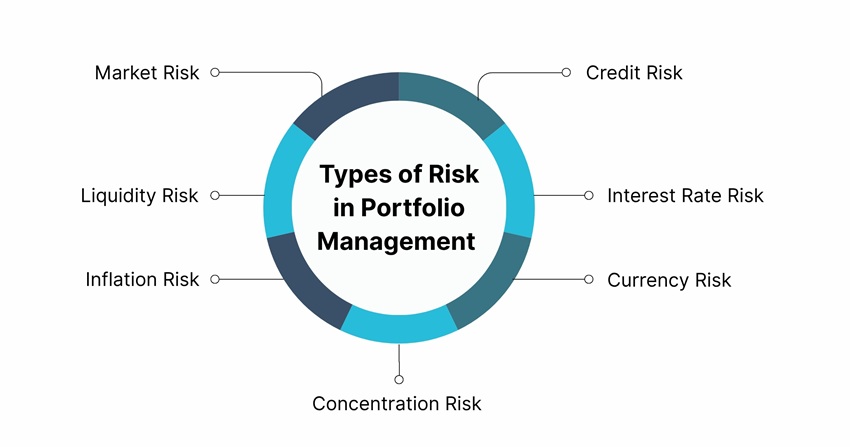
Types of Risk in Portfolio Management
To deal with risk, one needs to know the various types of risk in portfolio management. All the types have different impacts on investments.
Market Risk
The systematic risk or market risk is a risk associated with the factors that influence the financial market in general. These are economic crises, political instabilities, and worldwide activities. They can trigger widespread market movement. This risk cannot be fully removed through diversification alone as it impacts the market as a whole.
Market risk affects nearly all asset classes, such as bonds, equities and commodities. The investors frequently monitor macroeconomic indicators to predict possible market shifts and adjust their portfolios accordingly. Factors that contribute to market risks are:
- Economic downturns and recessions.
- Political instability or policy changes.
- Global crises such as wars or pandemics.
- Broad market corrections and crashes.
Example: An abrupt crash of the stock market on most of the equities.
Credit Risk
Credit risk is the possibility that a borrower will be unable to repay a loan or meet other financial obligations. It is primarily connected to bonds, loans and other debt instruments. The value of the investment may also fall when credit quality declines. This is especially if the borrower’s financial condition weakens.
Investors who are holding debt securities must assess the repayment capacity of the borrower and creditworthiness before investing. Credit ratings from the agencies often help in evaluating this type of risk. The common credit risk factors include:
- Default by a borrower or bond issuer.
- Downgrading of credit ratings.
- Delayed interest or principal payments.
- Financial weakness in the issuing company or institution.
Example: A company defaulting on its corporate bonds.
Liquidity Risk
Liquidity risk is the inability of an asset can not be sold quickly at a fair price. Some investments may appear valuable on paper, but when an investor wants to exit, there may not be enough buyers in the market. In such cases, the investor may have to accept a lower price or wait longer to complete the sale.
This risk is especially important in real estate, private equity, and rare or thinly traded assets. The less liquid an asset is, the more difficult it may be to convert it into cash without affecting its value. Liquidity risks include:
- Difficulty finding buyers in a short time.
- Need to sell at a discounted price.
- Longer exit time from the investment.
- Common in real estate, private equity, and niche assets.
Example: Selling property or rare assets can take time and may need price adjustments.
Interest Rate Risk
Interest rate risk refers to the impact of changing interest rates on the value of investments, especially fixed-income securities such as bonds. When interest rates rise, existing bonds usually become less attractive because newer bonds may offer higher yields. As a result, bond prices often decline.
This risk matters most to investors with large allocations in debt instruments. It can also influence loan costs, mortgage rates, and the overall valuation of income-generating assets.
- Bond prices typically fall when interest rates rise.
- Longer-duration bonds are usually more sensitive.
- Fixed-income portfolios face greater exposure.
- Borrowing costs may increase across the economy.
Example: An increase in interest rates normally decreases the price of a bond.
Inflation Risk
Inflation risk is the danger that rising prices will reduce the real value of returns over time. Even if an investment generates positive nominal returns, those returns may not be enough to preserve purchasing power if inflation rises faster. This risk is especially relevant for long-term investors and retirees.
Inflation can quietly erode wealth, making it important to invest in assets that can outpace it over time. Equity, real estate, and inflation-linked instruments are often used to help manage this risk. Inflation risk often manifests as:
- Reduces purchasing power over time.
- Affects long-term savings and retirement planning.
- Can make nominal gains less meaningful.
- Higher inflation may require stronger portfolio growth.
Example: When your portfolio is earning 6 percent and inflation is 7 percent, then the real return is negative.
Currency Risk
Currency risk arises when investments are made in foreign markets and exchange rate fluctuations affect returns. Even if the foreign investment performs well, a weaker foreign currency can reduce gains when converted back into the investor’s home currency. Likewise, currency appreciation can boost returns.
This risk is common in international investing, global mutual funds, and foreign bonds. Investors often evaluate exchange rate trends before allocating capital abroad. The factors that drive currency risk are:
- Affects overseas investments and foreign assets.
- Exchange rate movements can reduce returns.
- May add volatility to international portfolios.
- Relevant for exporters, importers and global investors.
Example: A depreciating foreign currency can decrease the returns on conversion.
Concentration Risk
Concentration risk occurs when too much money is invested in a single asset, sector, region, or company. If that specific area performs poorly, the entire portfolio may suffer significant losses. This risk is often caused by a lack of diversification.
A balanced portfolio spreads investments across different asset classes and industries to reduce dependence on one source of return. Concentration risk is especially dangerous when investors become overconfident in one winning sector.
Sources of concentration risk are:
- Overinvesting in one stock or company.
- Heavy exposure to one industry.
- Dependence on a single region or geography.
- Increased vulnerability to sector-specific downturns.
Example: Investing in just one sector, e.g. technology.
Advance Guide to Investment Banking Interview Questions
Download Now
How Portfolio Risk is Measured
It is not enough to have a conceptual understanding of risk; one must also quantify it. Many tools and indicators help with portfolio risk management. They give a clear view of risk.
Standard Deviation:
Standard deviation indicates the extent to which the returns differ with the average. It is considered to be one of the most widespread volatility indicators.
- Less value = Stable returns.
- Increased value = Increased volatility.
Beta (ß)
Beta is used to determine the sensitivity of a portfolio to the market.
Beta = 1 ? Trades with the market.
Beta > 1 ? More volatile than the market.
Beta < 1 ? Less volatile
Portfolio Risk Formula
A common formula calculates the risk (variance) of a portfolio with two assets:
s2p =
w12s12
+
w22s22
+
2w1w2s1s2?12
Where:
-
w1, w2 are asset weights
-
s1, s2 are standard deviations
-
?12 is the correlation between assets
Why it matters:
When two assets are not perfectly correlated, the overall risk can be reduced by combining the two.
Value at Risk (VaR)
VaR is a measure of the largest possible loss during a given time at a certain confidence level.
Example: Having a daily VaR of 500 with a 95% confidence level implies that on the majority of days, losses cannot be greater than 500.
Sharpe Ratio
The Sharpe Ratio measures risk-adjusted returns.
Sharpe Ratio
=
Rp
-
Rf
sp
A higher ratio indicates better returns relative to risk.
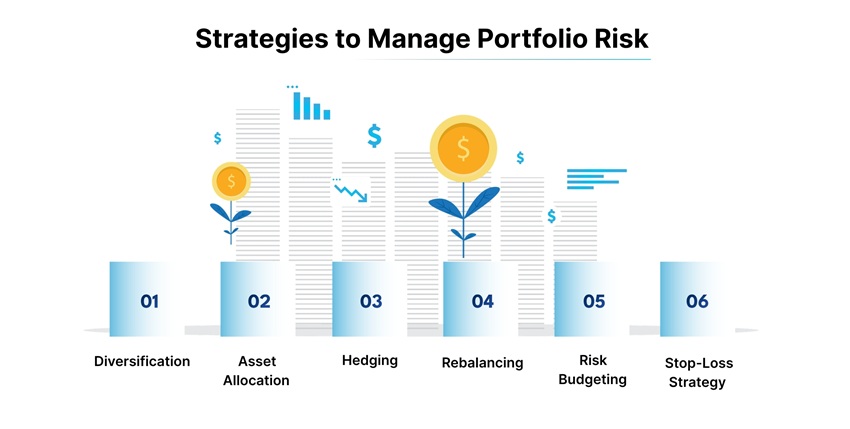
Strategies to Manage Portfolio Risk
After the measurement of risks, the second step is to control the risks. Successful portfolio risk management implies the use of practical strategies.
Diversification
Diversification spreads investments across various asset classes, sectors, and geographies to minimize total portfolio risk. By not putting all eggs in one basket, it reduces the impact of poor performance in any single area. This strategy works because different assets often move independently or inversely to each other.
The core principle is correlation because assets that don’t move together provide better protection. While diversification doesn’t eliminate risk entirely, it significantly lowers volatility and the chances of major losses.
Example: A diversification of stocks, bonds, and property rather than depending on one investment product.
Asset Allocation
Asset allocation involves dividing investments among different asset classes based on financial goals, time horizon, and risk tolerance. It determines the portfolio’s overall risk-return profile more than individual security selection. Proper allocation ensures the portfolio aligns with investor needs.
Aggressive investors favor growth assets like equities for higher returns, while conservative investors prefer stable fixed-income securities. Allocation should be reviewed periodically as market conditions and personal circumstances change.
Example: A moderate-risk investor might allocate 60% equities, 30% bonds, and 10% alternatives.
Hedging
Hedging uses financial instruments to offset potential losses in a portfolio. It acts like insurance, paying a premium to protect against adverse market movements. Common tools include options, futures, swaps, and inverse ETFs that move opposite to the underlying assets.
While hedging reduces downside risk, it also limits upside potential and involves costs. It’s particularly useful during uncertain times or for protecting specific positions rather than the entire portfolio.
Example: Hedging against market falls by using options or futures contracts.
Rebalancing
Rebalancing restores the portfolio to its original target allocation when asset values fluctuate over time. Strong-performing assets grow larger than intended, increasing risk, while underperformers shrink. Regular rebalancing sells winners and buys losers to maintain discipline.
This strategy enforces "buy low, sell high" automatically and controls risk drift. Frequency depends on transaction costs and tax implications, which is typically quarterly or annually.
Example: Selling assets with high performance and purchasing underperformed assets.
Risk Budgeting
Risk budgeting sets explicit limits on the amount of risk each investment or asset class can contribute to the total portfolio. It allocates "risk units" based on expected returns and volatility, ensuring no single position dominates overall risk. This approach treats risk as a scarce resource.
By measuring contributions using metrics like standard deviation or Value at Risk (VaR), investors can optimize the portfolio for maximum return per unit of risk. It’s especially useful for institutional investors.
Example: Limit any single stock to 2% of total portfolio risk.
Stop-Loss Strategy
A stop-loss order automatically sells an asset when it reaches a predetermined price, limiting losses during sharp declines. It removes emotion from decision-making and enforces risk discipline. Investors set thresholds based on percentage loss or technical levels.
While effective for cutting losses, stop-loss orders can trigger sales during temporary dips, potentially missing rebounds. They’re most useful for volatile assets or when conviction is low.
Example: Cashing in on a stock that has fallen by 10 percent to avoid more losses.
Tools Used in Portfolio Risk Management
Risk management cannot be effectively carried out without appropriate tools. The current investor depends both on conventional and online solutions. These platforms render performance, allocation, and risk exposure insights.
Risk Analytics Tools
Applied in the higher order of calculations like:
- Value at Risk (VaR)
- Stress testing
- Scenario analysis
Financial Models and Spreadsheets.
Excel is still extensively used in:
- Using the formula of portfolio risk.
- Running simulations
- Analyzing trends
Robo-Advisors
Robo-advisors create and run portfolios via algorithms. They assist in keeping the diversification and rebalancing the portfolios on a regular basis.
Simulation Tools
Simulation tools are used to simulate thousands of scenarios in order to make predictions of possible outcomes and risks.
Conclusion
Successful investing goes beyond selecting high-performing assets as it requires a clear understanding of the risks that will shape their outcomes. Consistent application of risk measurement and management practices supports more stable portfolio outcomes over time. They should use the portfolio risk formula and apply effective strategies and tools.
Applying these principles consistently gives investors a structured basis for making allocation decisions under uncertainty.