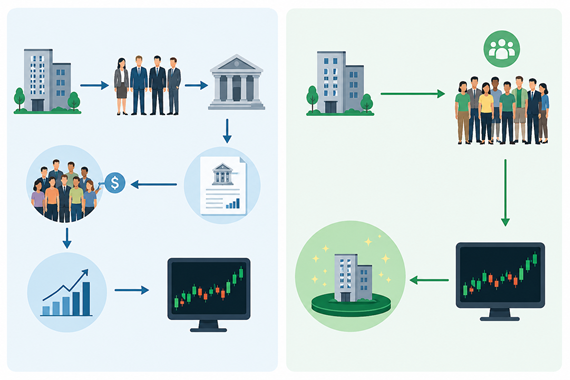
A private company usually faces a choice between a traditional initial public offering (IPO) or a direct listing when they want to trade on a stock exchange. In an IPO, the company issues new shares with the help of investment banks.
On the other hand, in a direct listing, existing shares start trading on the exchange without underwriters or new shares. Both give access to public investors, but serve slightly different goals, involving different costs and risks.
Read on to find out why companies go public, then look at the comparison between direct listing vs IPO in detail to understand what each route means in practice.
What is an IPO and How Does it Work?
An IPO or Initial Public Offering refers to the event when a private company sells newly issued shares of stock to public investors. The company associates with investment banks acting as underwriters. These institutions manage share issuance. These banks prepare regulatory paperwork, market the stock to large institutional buyers and guarantee a baseline share price before public trading begins.
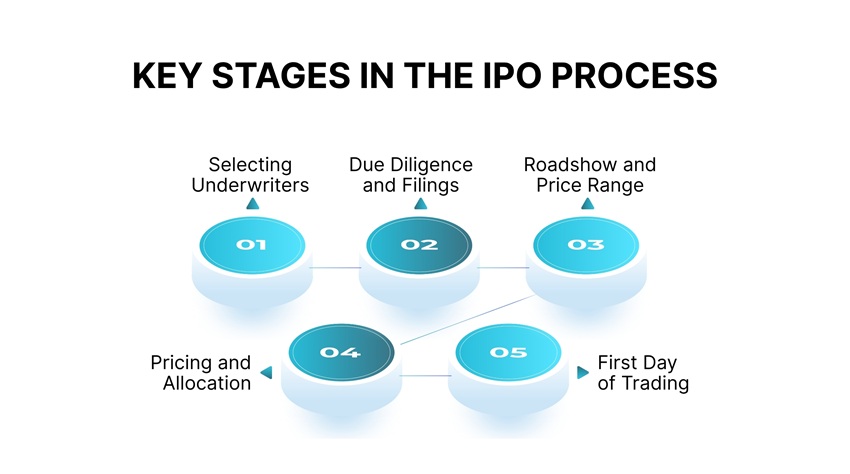
Details may vary but the IPO steps are usually as follows:
-
Selecting underwriters
The company chooses one or more investment banks to lead the IPO. These underwriters help structure the deal, set the offer price, and market shares to potential investors.
-
Due diligence and filings
The company and underwriters conduct due diligence, preparing audited financial statements and a DRHP (Draft Red Herring Prospectus). Regulators review this document before approving the offering to proceed.
-
Roadshow and price range
The company executives and underwriters meet with institutional investors at a ‘roadshow’. They discuss business models, finances, and expansion goals. The underwriters adjust the evaluated price range and demand in response to investor feedback.
-
Pricing and allocation
The underwriters and the company reach an agreement on the final offer price on the listing day. Shares are subsequently distributed to investors, including major institutions and long-term holders.
-
First day of trading
The stock starts trading on the exchange. The opening price may differ significantly from the offer price, depending on whether demand is high or weak.
Advance Guide to Investment Banking Interviews
Download Now
Key Features of an IPO
A few features define IPOs:
-
New capital raised -
The company creates and sells new shares to bring fresh capital onto the balance sheet.
-
Share dilution -
Existing shareholders own a smaller percentage of the company after the IPO as new shares are issued.
-
Lock-up periods -
Employees, founders and early investors are frequently restricted from selling their shares for a set period of usually 90 to 180 days. This lock-up avoids sudden selling pressure right after the listing.
-
Underwriter support and marketing -
They support the stock price in early trading through stabilizing transactions, providing research coverage and investor outreach to help the company attract attention in the public market.
Where IPOs focus on raising capital and leveraging underwriter support to manage pricing and distribution, direct listings prioritize liquidity and market-driven price discovery with minimal reliance on underwriting.
What is Direct Listing?
A direct listing is a way for an already well-funded private company to go public without issuing new stock or raising fresh capital. The company registers existing shares and lets current shareholders sell them directly on the exchange. There are no traditional underwriters who buy the shares first.
The main goal of a direct listing is:
-
To give liquidity to existing holders
-
Make the shares tradable
-
Gain the benefits of being a public company
What Does the Direct Listing Procedure Involve?
The direct listing steps shares some elements with an IPO but has primary differences:
1. Regulatory preparation
The company still prepares a registration statement, similar to an S-1, with detailed financial and business information. Regulators review and approve it before shares can trade.
2. Meeting exchange requirements
The company must meet listing standards, such as minimum market value and number of shareholders. Exchanges may have special rules for direct listings relating to valuation and float.
3. Opening auction and price discovery
The exchange runs an opening auction on the day of the listing. Buyers and sellers submit orders and set the opening price where supply meets demand. There is no preset offer price.
Because there is no bookbuilding by underwriters, the price in a direct listing comes more directly from market forces. This can mean faster price discovery but also more early volatility.
Key Features of a Direct Listing
Some features stand out in a direct listing:
-
No new capital raised at listing:
The company does not issue new shares, so it does not receive cash from the listing event. Any money changing hands goes from new investors to existing shareholders who sell.
-
No traditional underwriters:
Companies sometimes hire financial advisers but there are no underwriters who guarantee the sale or stabilize the price. This can cut costs and reduce potential conflicts of interest.
-
No traditional lock-up:
In most direct listings, early investors and employees can sell their shares immediately once trading starts. This allows faster liquidity but can also create selling pressure in early days.
These structural points are frequently at the center of the discussion when investors and founders compare direct listing vs IPO.
Direct Listing vs. IPO: A Clear Comparison
Here is a clear comparison table to look at direct listing and IPO across key dimensions.
| Dimension |
Direct Listing |
IPO |
| Primary objective |
Provide liquidity and public visibility as capital raising is not the main goal. |
Raise fresh capital to fund growth, pay down debt, or finance acquisitions. |
| Shares sold |
Only existing shares are sold by current shareholders; no new shares created. |
New shares are issued and sold to investors, increasing total shares outstanding. |
| Capital raised at listing |
The company typically raises little or no new capital in the listing itself. |
The company raises significant funds from the sale of new shares. |
| Underwriter involvement |
No traditional underwriters; company handles pricing and investor outreach itself. |
Investment banks underwrite the deal, market the offering, and help set the offer price. |
| Pricing method |
Opening price set by market supply and demand via exchange auction. |
Offer price negotiated between company and underwriters based on investor demand. |
| Costs and fees |
Lower overall fees because there are no underwriting commissions. |
Higher costs due to underwriting, roadshows, and related advisory fees. |
| Lock-up period |
Typically no traditional lock-up; insiders are often free to sell at listing. |
Commonly 90–180-day lock-up restricting insider sales after the IPO. |
| Price volatility |
Often higher early-day volatility due to purely market-driven pricing. |
Underwriters may stabilize trading, which can reduce initial volatility. |
| Dilution to existing holders |
No dilution from new share issuance; ownership percentages are preserved. |
Existing shareholders are diluted when new shares are issued. |
| Company profile that fits best |
Well-known, well-funded companies with strong brands and investor awareness. |
Companies that need capital and may benefit from bank led marketing and support. |
An IPO becomes the right choice when a firm needs capital and values the support of underwriters, while direct listings suit companies that already have strong balance sheets and need cost efficient liquidity for existing shareholders.
Case Studies of IPO and Direct Listing
To illustrate these differences, consider two notable recent listings of case studies.
Traditional IPO: Zomato
Zomato’s 2021 IPO shows the traditional path in action. The company raised large capital through a book-built offering, and public demand was strong, with the issue reportedly oversubscribed 38.25 times.
These two examples show the key contrast in direct listing vs IPO. Spotify used the market mainly for liquidity and price discovery, while Zomato used an IPO to raise growth capital and expand on a larger scale.
Direct Listing: Spotify
Spotify used a direct listing in 2018 and this is a notable example. The company did not need to raise large new funds. The method helped early investors and employees sell shares while keeping pricing open to the market.
Conclusion
There is no single universally “best” route for going public. These two concepts involve differing balances of capital raising, cost control, and risk. That is why the best choice depends on:
-
The capital needs of a company
-
Brand strength
-
Shareholder goals
-
Readiness for public market scrutiny
Investors and employees must understand how direct listing and IPO structures affect liquidity, dilution and early price behavior. Clear knowledge of these mechanics will help to read upcoming listings professionally and make more informed decisions.