The Convergence Powering Modern Deal Making
An investment banker’s calendar rarely stays inside one industry anymore. In a single week, the same desk might negotiate a fiber network upgrade, price a streaming platform’s content budget, and advise on a semiconductor supply deal. This is the scope of TMT investment banking, a coverage group centered on three sectors including technology, media, and telecommunications. These industries were segmented a generation ago, and there was not much overlap in how deals or clients were handled. Now they sit side by side because the value chain of content, delivery, and consumption has become increasingly interconnected. Software produces the content, networks transport it, and devices deliver it to the end user.
This article explains how TMT investment banking is structured, which types of transactions dominate the group’s deal activity, how valuation frameworks differ across its subsectors, and what a career in the group looks like in practice.
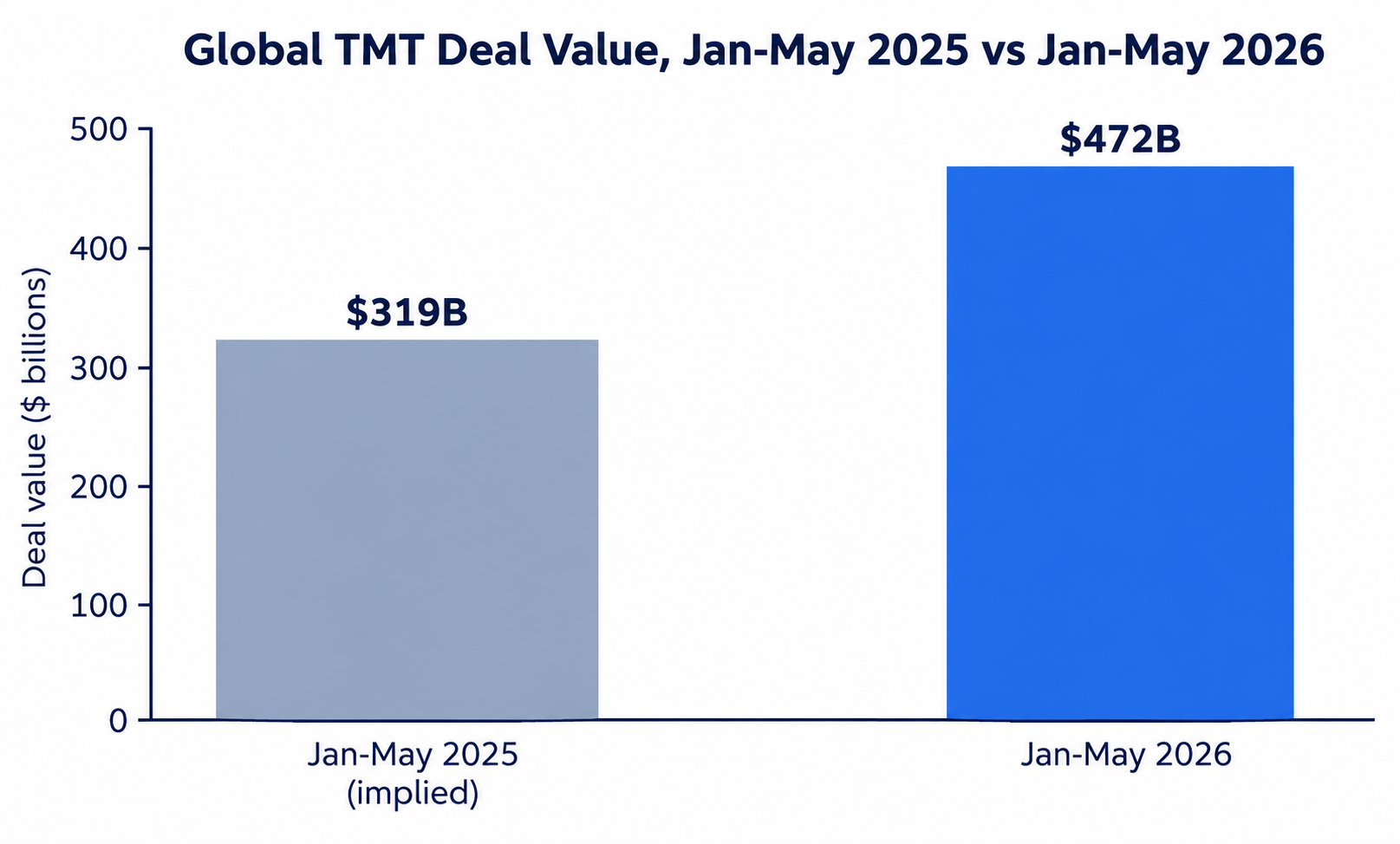
PwC’s Global M&A Trends in TMT: 2026 Mid-Year Outlook shows that deal values in the TMT sector climbed 48 percent to reach USD 472 billion in the first five months of 2026.
Data Source: PwC — Global M&A Trends in TMT: 2026 Mid-Year Outlook
Defining the Three Pillars That Make Up the Sector
This technology sector is broad and comprises software companies, manufacturers of hardware, internet platforms, and fintech companies that produce the tools people use every day. The media and entertainment sector follows, encompassing streaming services, gaming studios, publishers, and advertising networks that create and sell content. The telecom sector finishes off the group with wireless carriers, broadband providers, satellite operators, and the physical infrastructure used for transporting data from source to screen.
These days it’s not common for businesses to remain confined to a single niche. A wireless company that previously sold voice minutes might now generate revenue through digital content and entertainment offerings. A consumer software company may also earn more from advertising than from licensing. Netflix evolved from a DVD-by-mail business into a global streaming platform and major producer of original content. AT&T was primarily known for its telecommunications business before expanding into media through its acquisition of Time Warner in 2018, a transaction that brought WarnerMedia under AT&T’s ownership before the business was later separated and merged with Discovery in 2022.
These boundaries have blurred, which is why these sectors are grouped together. Deloitte’s TMT Predictions 2026, estimates that global advertising revenue for podcasts and vodcasts will reach about USD 5 billion by 2026, representing an almost 20 percent year-over-year increase. Figures such as that are precisely the reason why banks now need to be competent in all three areas rather than just one.
How Media Advisory Differs from Telecom Coverage
Although media and telecommunications are grouped together, they are moving in opposite directions. Telecommunications acts like a utility, with spectrum and networks being considered public goods, demand remaining steady even during economic downturns, huge amounts being spent on infrastructure, and regulators keeping a close eye on mergers. The media and entertainment sector, on the other hand, is geared toward growth: it is based on hits, and its revenue comes either from advertising or subscriptions, both of which can change dramatically depending on a single failure or a major success.
The advisory approaches used across the two sectors are also quite different. A telecom assignment typically focuses on issuing debt, taking part in spectrum auctions, and securing infrastructure financing, since large-scale mergers and acquisitions (M&A) face serious regulatory and cross-border obstacles. In contrast, a media investment banking engagement could involve a digital content platform raising equity to finance its programming, or a traditional newspaper group restructuring its balance sheet as print circulation falls. Bankers specializing in telecom are more concerned with subscriber economics and average revenue per user (ARPU), whereas those working in the media sector place greater importance on the value of the content library and on how long a platform can retain its audience.
The gap is continuing to widen as connectivity becomes a commodity. Deloitte’s TMT Predictions 2026 projects that the number of global direct-to-device satellite subscribers will exceed 15 million by the end of 2026, supported by more than 15,000 satellites in orbit.
The Deal Types That Define Activity in This Space
The pace at which deals happen in the TMT sector is seldom uniform. In the technology area, there is a steady stream of transactions consisting of strategic acquisitions in which large companies take over smaller ones, private equity transactions involving software businesses that have a proven track record of subscription revenue, and, from time to time, mergers between medium-sized firms seeking to increase their scale. Spin-offs and divestitures also occur when large conglomerates determine that a particular business unit no longer aligns with their strategy.
Capital markets activity proceeds alongside all of this. In the technology sector, initial public offerings (IPOs) are still a key feature, together with follow-on equity offerings, convertible notes, and both investment-grade and high-yield debt issues. Telecom operators rely largely on debt due to their high level of capital intensity, whereas media companies tend to use equity markets more frequently to finance content investments. Restructuring activity is most apparent in sectors going through decline, such as radio, print, and linear television, where balance sheet solutions matter more than conventional M&A advice. This exposes analysts to distressed situations they might not encounter elsewhere.
Volume continues to favor one corner. FE International’s Mid-Year 2026 Tech M&A Report shows that the total value of global announced mergers and acquisitions reached a record USD 2.8 trillion in the first six months of 2026, with technology alone accounting for USD 649 billion of that amount.
Valuation Methods and Modeling Considerations Unique to TMT
The earnings before interest, taxes, depreciation, and amortization (EBITDA) multiple is not equally applicable across all areas of the TMT sector. Software companies are generally valued using revenue or annual recurring revenue (ARR) multiples, since their near-term earnings do not adequately reflect their long-term potential. Telecom operators use subscriber numbers, ARPU, and the value of their infrastructure assets, since their business is based on physical networks rather than intellectual property. Media companies lie somewhere between the other two, combining subscriber metrics with an assessment of content library value and how long their franchises will last.
Things become even more complicated with conglomerates involved in more than one sub-sector. When a company has, for example, a telecommunications arm, a media division, and a technology unit all operating under the same roof, a sum-of-the-parts approach is usually required, since each of these units needs its own valuation method before being added back together. The presence of joint ventures and minority interests, common throughout the industry, introduces an extra layer to the enterprise value calculation that a simpler industrial company is seldom required to handle.
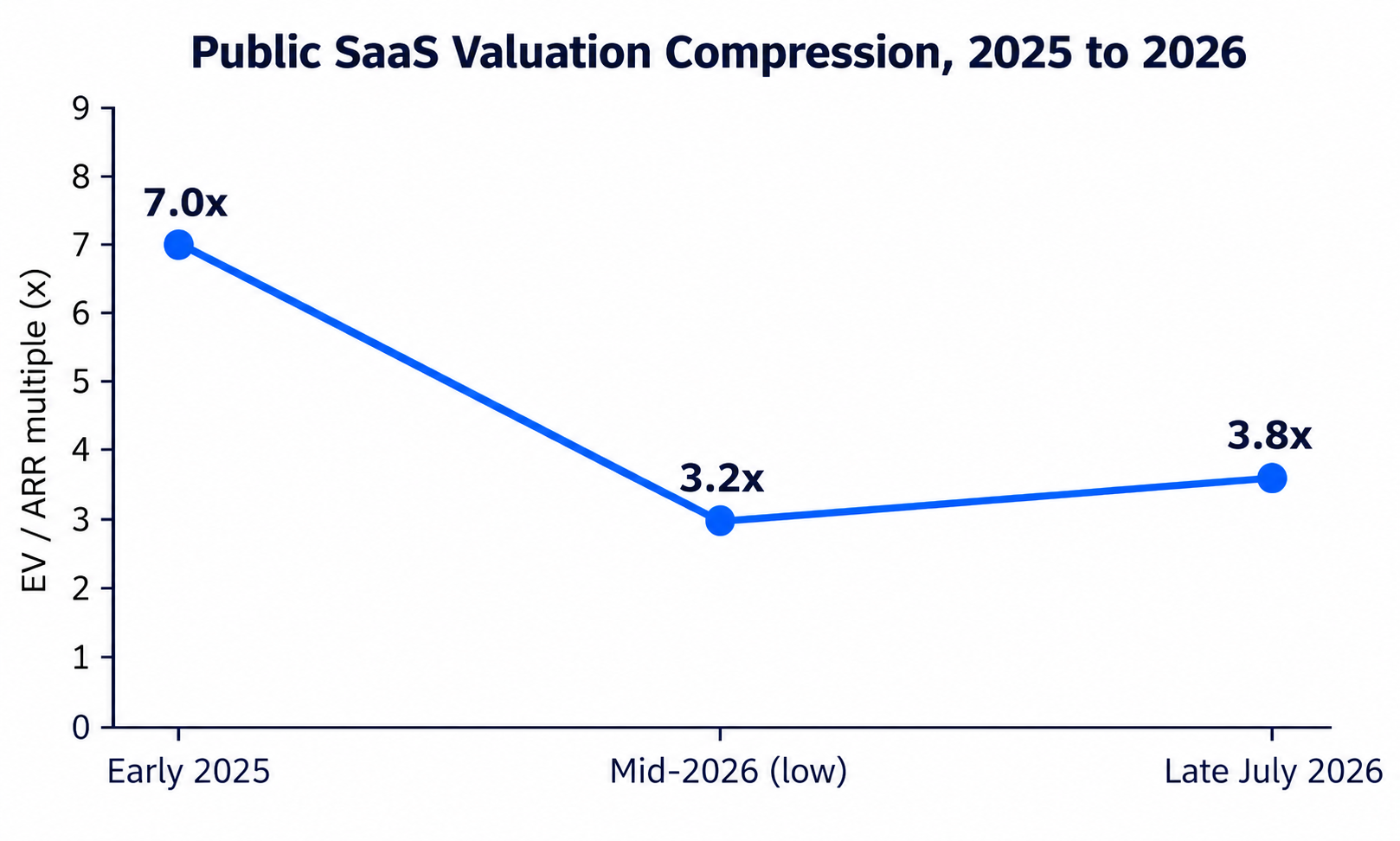
Streaming has introduced its own kind of modeling approach. Firms that treat content spending as an asset, then spread the cost over several years, produce cash flow statements very different from those of a normal software business. Valuation multiples also reflect this variability. L40 Insights, which monitors the SaaS Capital Index, reported that the median figure for public software-as-a-service (SaaS) companies stood around 3.8 times annual recurring revenue as of late July 2026, a sharp decline from the levels observed a few years before.
The multiple bottomed out mid-2026 before a partial recovery, a pattern that continues to shape how bankers frame software valuations in current pitches.
Data Source: L40 Insights, SaaS Multiples
Who Leads the Market and Where Deal Flow Concentrates
All of the bulge bracket banks have extensive TMT franchises, although each has its own standing within the group. Some have developed technology-focused deal books as a result of decades of relationships with software and internet companies, while others have particular strength in the media and telecom sectors, supported by balance sheets big enough to back heavy debt issuance for capital-intensive carriers.
Elite boutiques occupy a distinct niche within the market. Some have built up their reputations around cross-border transactions or restructuring cases, an area in which a conflict-free advisory approach is attractive to boards considering various strategic options. There is also a smaller group of specialized boutiques that narrow the focus even further by concentrating almost entirely on a single sub-vertical, such as technology M&A or media and entertainment advisory.
Data on market share from early 2026 clearly demonstrate how concentrated advisory revenue still is at the top, with Goldman Sachs leading the Q1 2026 Americas M&A league table with USD 159.3 billion in advised deal value across 49 transactions, a 28.7 percent share:
| Bank |
Advised Deal Value |
Market Share |
Deal Count |
| Goldman Sachs |
$159.3B |
28.7% |
49 |
| J.P. Morgan |
$116.8B |
21.0% |
54 |
| Citi |
$82.3B |
14.8% |
22 |
| Morgan Stanley |
$68.5B |
12.3% |
42 |
Technology volume is still influencing staffing choices at almost every bank on that list.
Career Trajectory and the Skills That Set Candidates Apart
Banks do not usually reward general enthusiasm for a booming sector when recruiting for TMT. Instead, they prefer a candidate able to explain a business model with real fluency, for example by discussing net revenue retention in the case of a software company or spectrum economics in the case of a wireless carrier. Just as in any other coverage area, a solid grasp of financial modeling matters just as much as interest in the sector itself; that sector interest complements the essential skills rather than replacing them.
The opportunities available to people leaving the group are unusually broad. Private equity firms that focus on technology tend to recruit heavily from TMT analyst classes, drawn to candidates who already understand recurring revenue models and the trade-off between growth and profitability. Growth equity firms, venture capital firms, technology-focused hedge funds, and corporate development departments at large media and technology companies all draw their staff from the same pool of applicants.
Capital continues to support this buyout activity. PitchBook’s 2026 US Private Equity Outlook suggests that platform buyouts are expected to make up at least one quarter of all private equity transactions this year, and the ten largest funds are projected to secure more than 40 percent of all fundraising capital. Sector expertise gained early on in a TMT seat tends to build up and reinforce itself along each of these routes over time.
Why TMT Remains a Distinct Investment Banking Sector
TMT brings together content, connectivity, and computing within a single coverage group. Most other coverage groups do not require bankers to develop expertise across three distinct business areas or valuation frameworks within one role. It is this broad scope that keeps the group relevant to analysts, associates, and clients alike.
Capital continues to confirm demand at the macro level. PwC’s Global M&A Industry Trends: 2026 Mid-Year Outlook projects that global M&A value will reach approximately USD 4 trillion for the year, a 13 percent increase over 2025, and the strongest total since 2021.
TMT investment banking remains important because technology, media, and telecommunications increasingly influence one another while continuing to operate under very different business models and valuation frameworks. The sector brings together high-growth technology companies, content-driven media businesses, and capital-intensive telecom operators, creating a broad range of M&A, financing, and restructuring opportunities. For bankers and investors, understanding these differences and the connections between the three sectors is what makes TMT one of the most complex and strategically important coverage areas in investment banking.