Introduction
Money operates silently behind the scenes in any economy, facilitating trade, settling debts, and sustaining financial systems. This motion is brought to light by the money market. It acts as the center of short-term lending and borrowing, whereby liquidity flows. The market provides an interconnection between governments, corporations, and financial institutions through a trust network and time. It is important to understand structure and functions of money market to appreciate why it is necessary for the stability and growth of the economy.
The Core Purpose: Maintaining Short-Term Liquidity and Stability
Money-market instruments in a financial system play a major role in ensuring that short-run stability is maintained because they balance temporary cash surpluses and deficits. The market allows banks, corporations, and government bodies to handle day-to-day funding and liquidity in an effective manner. The parties that have surplus funds can be tapped by the others that have short-term commitments, and they keep the system flowing and responsive.
The major processes of this central action are:
-
Liquidity transfer: Surplus funds are channeled into short-term instruments, providing liquidity to those who need it and promoting efficient cash flow.
-
Risk mitigation: The availability of short-term instruments through the market assists institutions in avoiding the risk of defaulting on immediate payment liabilities, thus contributing to the overall financial stability.
-
Stabilization of borrowing costs: The stable supply of short-term cash averts huge fluctuations in the day-to-day rates of interest. Which strengthens trust in the market to support operational and transactional interest rates.
As an example, the short-term funding market was essential in 2025. It was observed, in one study, that money markets are vital in liquidity management as banks and nonbank clients rely on them for rebalancing their liquidity.
This stabilizing effect explains how the money market helps in the stabilization of the wider financial system, minimizing the risk of cash-flow crises, and increasing confidence in operations.
Price Discovery and Interest Rate Benchmarking
Price discovery and the setting of interest rates, in the context of money-market functions, are the key central mechanisms that drive the broader financial system. A market offers a platform in which the price of short-term funds is arrived at through the supply and demand among the banks, governments, and even large institutions.
-
The price discovery is effective when the surplus is shifted or when the demand is shifted. The prevailing rates are at that time adjusted to reflect real-time liquidity conditions, credit risk, and macro expectations.
-
Interest rate benchmarking is obtained through short-term rates that are charged in the money market. Such rates are used as reference points for floating-rate loans, commercial paper, and interbank borrowing and anchor prices in sectors. For example, according to the Federal Reserve Board’s selected interest-rate release, the 1-month Treasury yield averaged 4.01 percent in November 2025, demonstrating how short-term rate benchmarks track underlying funding conditions.
Collectively, these operations assist the financial system on both counts. They allow the efficient distribution of short-term funds, and secondly, they allow lending and borrowing conditions in other parts of the economy to reflect the underlying costs of funds. The benchmarking role of the money market thus plays a significant part in the transmission of interest rates to the various sectors.
Financing Trade and Business Operations
The money market provides essential short-term funding that keeps trade and business operations running smoothly. Corporations are usually subject to these mismatches in cash-flow timing, such as paying suppliers or labor waiting to receive payment in the form of receivables. The money market provides products that enable companies to fill such gaps, ensuring the continuity of working capital as well as operations without long-term debts.
Practically, this is played out in several ways:
-
Issuing commercial paper: Large corporations can issue unsecured promissory notes with a maximum maturity of 270 days, which allows large corporations to borrow to satisfy inventory requirements, payroll, or seasonal requirements.
-
Certificates of deposit (CDs) and money market funds: These provide companies with a safe outlet to stash surplus cash or borrow short-term funds as and when required, which is optimal for working capital management.
-
Short-term borrowing by use of repurchase agreements (repos): The businesses have a temporary opportunity to sell the security with an agreement to buy it at a slightly higher price to provide quick access to money needed by the business to meet urgent operating costs. This approach stabilizes working capital when there is high demand, and the firms can continue with the business without interfering with their long-term investment strategies.
The companies can escape committing themselves to extended maturities or rising financing expenses through these channels. They also enjoy the flexibility and liquidity of the money market by matching the time of funding with the time of operation, and this is the essence of the money market in assisting trade and business operations.
Safe Investment Avenue for Short-Term Funds
When investors need a steady place to park cash with limited risk, the money market serves as a reliable option. Its structure is built around short-maturity, high-quality instruments that help preserve capital while keeping funds accessible for near-term use. This makes it a practical choice for individuals and institutions to manage temporary cash balances.
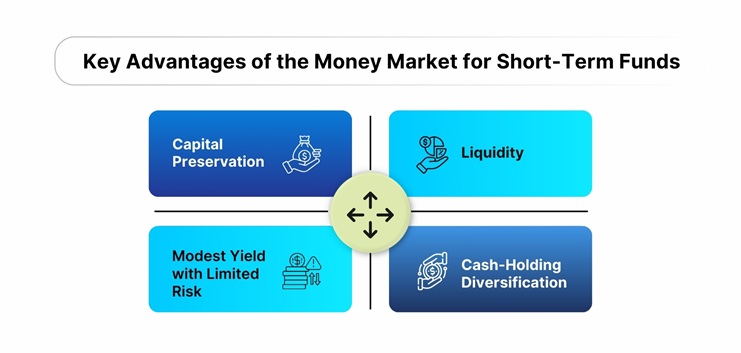
Major benefits of the money market as a short-term investment:
-
Capital preservation: Money-market instruments are generally short-term, high-credit-quality instruments. The features minimize exposure to significant fluctuations and are highly appropriate when the investment time is short.
-
Liquidity: Due to the relatively short maturities of as little as days to less than a year, investors still have room to turn their money in as quickly as possible. This renders the market very convenient to keep money pending until the occurrence of immediate liabilities or opportunities.
-
Modest yield with limited risk: The returns are normally lower than long-term equities or bonds, but their risk profile is reduced substantially. This trade-off is the one that is attuned to the aim of investors seeking to rely on access and safety rather than growth.
-
Portfolio diversification of cash holdings: Cashing cash in checking accounts yields low returns, and it should not be left to sit there when there are other ways to use it, so it is better to place part of the cash in short money-market instruments to have it under management but readily available.
Monetary Policy Implementation and Economic Control
Money markets play a fundamental role in carrying out the monetary policy and maintaining a stable economy. Central banks manipulate the liquidity in the entire financial system by regulating the supply and price of short-term funds, influencing credit availability. This allows policymakers to manage inflation and economic growth without necessarily having to interfere with long-term markets.
Key mechanisms include:
-
Open market operations: The central banks purchase or sell short-term government securities to control liquidity and maintain short-term interest rates at desirable levels.
-
Lending and deposit facilities: Central banks establish a range in which the interest rates in the market stabilize by dictating the borrowing and deposit rates.
-
Reserve requirement adjustments: When the reserve banks change the amount of reserves that the banks have, this affects the level of money that will be given out as a loan and the rate of credit generation.
Conclusion
The operations of the money market are the basis of contemporary financial stability, providing the stability of liquidity, influence of short-term rates, and facilitation of effortless business and government financing. Its networked design facilitates efficiency, institutional trust, and responsiveness of capital flows to market demands. The money market is also important, as it has the capacity to evolve continuously and maintain economic growth and financial robustness across the globe.