Every business reaches a point where its cash flow cannot support its ambitions. Whether entering new markets or developing new products, companies need to raise capital. They use capital raising strategy through equity sales, bank loans, bonds, or hybrid instruments. This process shapes everything from ownership structure to financial risk. Understanding how capital is raised enables better decision-making.
Recent public market activity illustrates how rapidly conditions can change. In the first quarter of 2026 as published by the Securities and Exchange Commission (SEC), the U.S. saw 99 IPOs raising over USD 22 billion, versus 84 IPOs raising over USD 11.8 billion a year earlier, and 264 follow-on registered offerings raised over USD 44.2 billion. These are big swings in a short time, and they affect pricing and timing for companies of all sizes.
What "Capital Raising" Means
Capital Raising means investing money in the business to achieve a specific outcome, such as launching a product, opening a new location, buying another firm, or refinancing expensive debt. It can come from within the business, such as retained earnings, or from outside investors and lenders.
The Three Questions That Matter
Before you compare options, align on three basics:
- How much do you need, and by when: A USD 500,000 need in 60 days pushes you toward fast options. A USD 50 million growth plan may justify a longer process.
- What the money will pay for: Investors and lenders want a specific use of funds, with measurable milestones.
- What a good outcome looks like: Decide what you will protect, such as control, flexibility, or a target total cost.
Once these three are clear, you can build a funding strategy that fits your timeline and your risk level.
Core Methods of Capital Raising
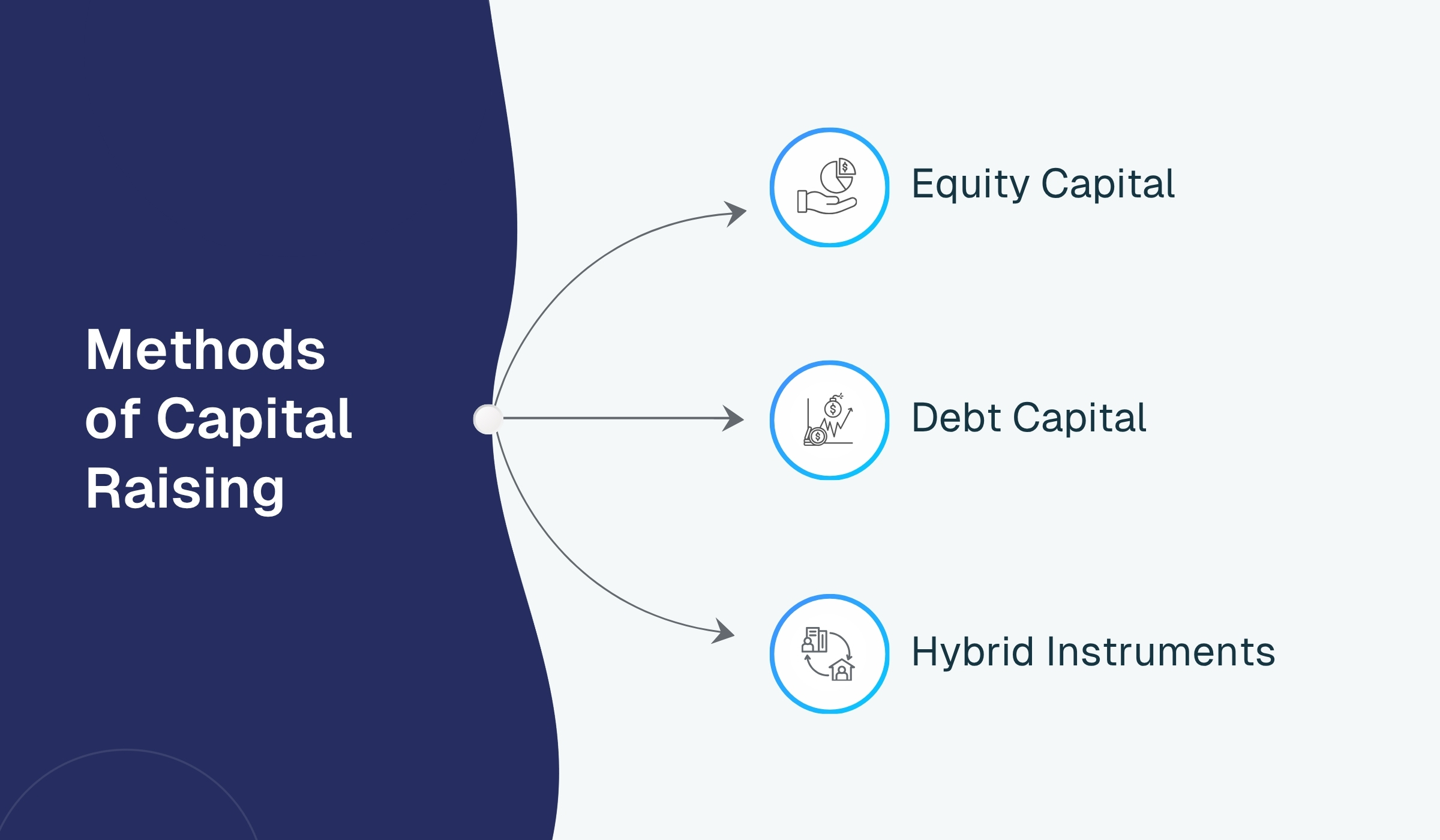
The methods of capital raising fall into three main categories, including equity, debt, and hybrid instruments. Each carries different implications for ownership structure, financial obligations, and flexibility.
1. Equity Capital
Selling equity means giving investors ownership stakes. A startup founder may sell 20 percent of the business to a venture capital firm for USD 2 million. The founder retains 80 percent but shares decision-making power with the new investor. This form of capital raising never requires repayment.
Equity comes in two types:
- Common stock
- Preferred stock
Common stock grants shareholders voting rights but ranks lower in repayment priority during bankruptcy, while preferred stock, which is commonly issued to institutional investors, offers preferential dividend treatment. Public companies typically raise equity through initial public offerings (IPOs), whereas private companies secure equity funding from angel investors and venture capitalists.
2. Debt Capital
Borrowing money creates a legal obligation to repay principal plus interest. Unlike equity, debt does not transfer ownership. The business remains in the founder's hands, but they must service the debt regardless of profitability. Banks offer traditional term loans where a firm borrows a fixed amount and repays it over a set period. Bonds work similarly but appeal to larger companies. Revolving credit lines function like corporate credit cards.
Debt provides distinct advantages. The firm avoids ownership dilution, and founders retain full control. Interest payments are often tax-deductible. However, debt creates financial risk. If revenue drops, the venture still must make payments. Creditors can seize assets if they cannot pay. This is why companies with stable revenue streams favor debt, while volatile early-stage companies prefer equity.
3. Hybrid Instruments
Many companies use instruments that blend debt and equity characteristics. Convertible notes start as loans but allow investors to convert them into equity at a future date. Mezzanine financing sits between traditional debt and equity, offering higher returns to investors. These approaches allow companies to tailor capital raising to their specific situation.
The Capital Raising Process
After you choose a direction, execution matters, because most delays come from preparation gaps, unclear numbers, and slow decision-making. The process from identifying capital needs to fund deployment can take several months.
Regardless of the financing method, the capital raising journey follows a structured process. Each stage requires careful planning and coordination to improve the likelihood of a successful outcome.
Step 1: The company must first assess its funding requirements by determining the amount of capital needed and its intended use. A business requiring USD 100,000 within three months will have markedly different financing options than one seeking USD 10 million.
Step 2: Then comes preparation. Financial statements must be in order. The organization needs a clear business plan and detailed financial forecasts showing projected cash flow, revenue, and expenses.
Step 3: The establishment selects the capital source. Will it approach banks, private equity firms, venture capitalists, bond markets, or some combination? Banks typically take four to eight weeks to approve loans, whereas venture capital investors might take three to six months.
Step 4: It involves marketing and negotiation. The enterprise pitches its story to potential investors or lenders, and the lawyers negotiate terms. Due diligence verifies the company's claims.
Step 5: Finally, there is the closing, wherein both parties sign documents. The investor transfers funds while the enterprise receives its capital and begins executing its business plan.
Key Players in Capital Raising
Multiple constituencies shape how capital raising unfolds.
Within the company, the chief financial officer typically leads the capital-raising effort. External investment bankers or financial advisors guide the process, drawing on their networks and experience.
Outside the organization, investors and lenders make the actual funding decision. Banks assess whether they can repay loans. Venture capitalists evaluate whether the business can grow into a large, valuable business.
Private equity firms look for mature businesses generating reliable cash. Auditors verify financial information. Regulators ensure that public fundraising follows all applicable rules.
When capital raising crosses into public markets, through bond offerings or IPOs, the list of players expands to include underwriters, ratings agencies, and stock exchanges.
Strategic Considerations That Shape Cost, Control, and Timing
After you understand the options and the process, the final step is making choices with long-term consequences.
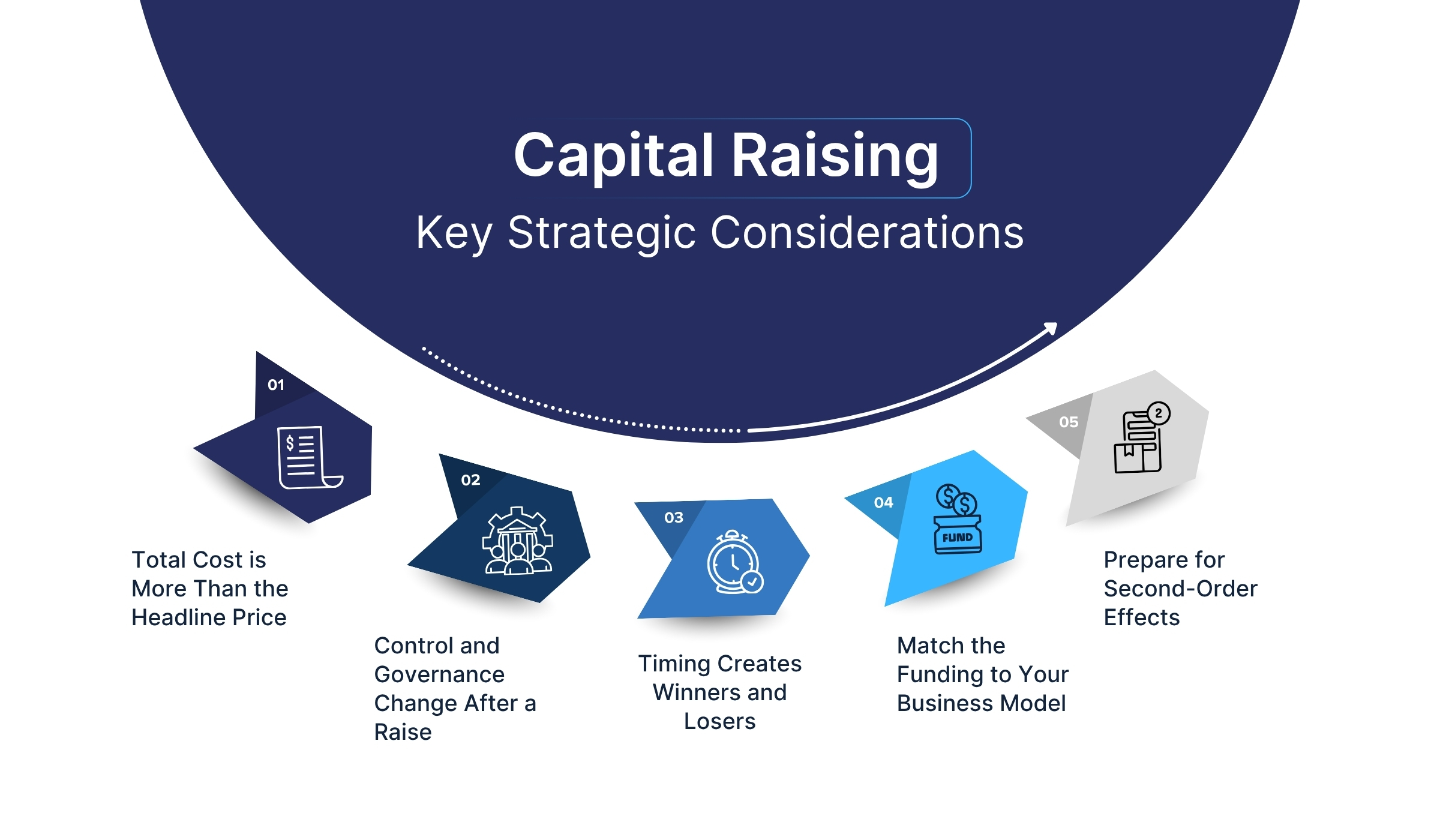
1. Total Cost is More Than the Headline Price
For debt, the cost is interest, fees, and any limits that reduce flexibility. For equity, the cost is today's dilution plus the value of the ownership you give up if the business succeeds.
Financing conditions remain sensitive to uncertainty and risk this year. The International Monetary Fund’s (IMF) April 2026 outlook highlights tighter financial conditions as a key pressure point for growth and inflation. That backdrop affects how investors price risk and how lenders set terms.
2. Control and Governance Change After a Raise
Equity investors often ask for board representation and certain veto rights. Lenders may require financial covenants that trigger action if performance dips.
Make sure your capital-raising strategy includes a decision-making plan after the money arrives, especially if there are multiple new stakeholders.
3. Timing Creates Winners and Losers
Timing matters because your authority changes. If you raise when cash is low, you accept worse terms. If you raise after hitting clear milestones, you often get better pricing.
4. Match the Funding to Your Business Model
A recurring-revenue business may handle revenue-based financing better than a project-based firm. A capital-intensive business may need longer-term debt or equity to avoid cash stress.
This leads to the mistake of choosing methods of capital raising based on what is popular, instead of what matches cash flow.
5. Prepare for Second-Order Effects
Funding choices affect hiring, pricing, and even customer perception. Public raising can increase trust for some buyers, but it also brings scrutiny. A lender's reporting needs can add workload to finance teams.
On a global level, the pressure on borrowing costs is also visible in public-sector data. The UN reports that 3 billion people live in countries where governments spend more on debt interest than on health and education combined, which is a reminder that debt costs compete with everything else.
Conclusion
Capital raising is not a one-size-fits-all exercise. The optimal capital raising strategy depends on the company's business model, growth stage, profitability, and market conditions. Understanding the methods of capital raising provides the foundation for smart decision-making.
Knowing the key players and what each brings to the table helps companies navigate negotiations effectively. Thinking through strategic considerations ensures that today's funding decisions support tomorrow's ambitions.
The companies that raise capital most successfully do so with a pragmatic approach to their situation and openness to advice from experienced advisors. They prepare thoroughly, communicate clearly with potential investors or lenders, and negotiate terms they can live with for years. They understand that capital raising is not the end goal but using that capital to build valuable, sustainable business value is.