Public finance investment banking connects U.S. state and local governments and public institutions to capital markets, enabling financing of long-term assets before revenues become available. Bankers originate and underwrite municipal securities for these borrowers and advise on the structuring of each issue.
The process combines credit analysis, structuring, legal considerations, and market timing. Companies organize the group into various divisions, some placing it in capital markets or fixed income and others in investment banking. Most transactions also involve bond counsel, a municipal advisor, and issuer finance staff working alongside the bank.
Public borrowing funds physical capital that communities across the country use daily, such as roads, bridges, hospitals, and airports. These transactions, which may take 20 to 30 years to pay off, affect taxpayers and bondholders for decades. Knowing how the discipline works is important to public officials and investors, as well as to professionals who advise them.
Definition and Scope of Public Finance Investment Banking
Understanding what public finance investment banking is beginning with the borrower, since every engagement serves an issuer with a public purpose. Bankers advise and underwrite securities that help these issuers obtain financing in the capital markets on terms that fit their funding needs and credit quality.
Corporate investment banking focuses on businesses that answer to shareholders and operate for profit. Public finance bankers serve borrowers whose obligations rest with the taxing authority or the project revenues, and whose decisions pass through elected boards and statutory limits. Credit analysis therefore looks at population trends and pension liabilities in addition to cash flow.
The scope ranges from school district borrowings of a few million dollars to multibillion-dollar programs for large states and transit systems. Federal tax treatment of interest significantly affects structuring decisions, including maturity schedules and the investment of unspent proceeds.
A typical coverage team includes a senior banker responsible for the client relationship, analysts who develop debt models, and credit specialists who prepare materials for rating agencies. Many companies structure these teams by region or sector, so bankers become familiar with the borrowers they serve. Bond counsel advises on the legal and tax aspects of each issue, while the team plans timing around the public approval calendar of each governing body.
Next, let’s examine the various types of clients served in public finance.
Government and Institutional Clients Served
Public finance bankers work with several categories of borrowers, each with a different source of repayment.
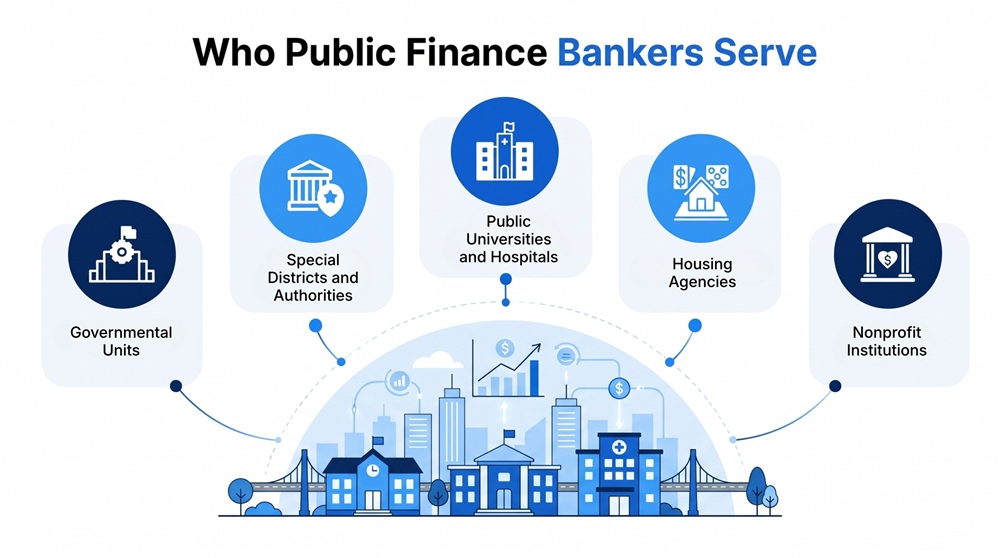
- Governmental units: States, counties, cities, towns, and school districts issue bonds supported by property, sales, or income taxes.
- Special districts and authorities: Water and sewer, port, airport, and transit agencies borrow against user fees, tolls, and fares.
- Public universities and hospitals: State universities and public hospital systems fund campuses and facilities through tuition payments, patient services, and grant revenue.
- Housing agencies: State and local housing finance agencies issue bonds to finance mortgage programs and affordable rental development.
- Nonprofit institutions: Private universities, nonprofit hospitals, museums, and senior living providers borrow through a government conduit issuer, which gives them access to tax-exempt markets, while the nonprofit remains responsible for repayment.
Each category raises its own credit questions. A state general obligation pledge is subject to a different analysis than a toll road, and both the analysis and the investor’s outreach are geared toward the borrower’s repayment source.
The size and experience of clients vary widely. A rural school district may issue debt once a decade, while a large state can turn to the market several times a year with its own internal finance staff. Bankers adjust the level of support to the experience of each issuer.
Financing Instruments and Bond Structures
The U.S. municipal bond market had USD 4.5 trillion outstanding as of the second quarter of 2026, up 4.8 percent from a year earlier, according to SIFMA Research’s US Municipal Bonds Statistics.
General obligation bonds are issued with the full faith and credit of the issuer and typically are secured by the taxing authority (e.g., property taxes). Revenue bonds depend on a particular source of revenue, like water rates or airport charges, and are not backed by general taxes.
Revenue bonds are tax exempt because they are used to fund public projects. Whether financing will be issued as tax-exempt bonds or as taxable bonds (which typically have higher yields) depends on rules concerning private business use and private payments.
Short-term notes, such as tax anticipation notes and bond anticipation notes, bridge the gap until taxes are collected or long-term bonds are issued. Refunding bonds replace outstanding bonds to reduce interest cost or change maturities. In 2017, federal tax law eliminated tax-exempt advance refunding.
Bankers choose among these structures based on the repayment source, the asset’s expected life, the issuer’s tolerance for interest rate volatility, and prevailing market conditions.
Advisory and Transaction Services
The main execution service is underwriting. The bank buys a new issue from the borrower (in a competitive sale or negotiated sale) and resells the bonds to investors. In a firm commitment, the bank bears the risk of unsold bonds. Pricing meetings and allocation of decisions are made in a limited time frame, often within one business day.
There are additional skills needed for advisory services. Bankers determine the debt capacity of the borrower, develop alternative scenarios of how the loans will be repaid at different interest rates and brief the issuer for meetings with rating agencies, which can influence the rating. Refinancing analysis is a procedure that looks at the current value of savings that could be achieved by replacing old debt with new debt and analyzes the issuance costs.
Swaps and caps are interest rate management instruments for financing with variable rate debt, and prior to entering into an agreement, bankers give the issuer a description of the counterparty and end-user risk.
Underwriters and municipal advisors hold distinct legal roles. An underwriter is a principal in an arm’s-length commercial transaction and has no fiduciary duty to the issuer. A municipal advisor registered under federal rules has a fiduciary duty to the issuer and must act in the issuer’s best interest.
Regulatory Framework and Deal Process
Municipal bonds are generally exempt from Securities Act registration with the Securities and Exchange Commission (SEC), although federal antifraud provisions still apply to municipal offerings and their disclosures. The Municipal Securities Rulemaking Board prepares rules for dealers and municipal advisors, including the fair dealing standard in Rule G-17. The Dodd-Frank Act of 2010 brought municipal advisors under regulation.
Under SEC Rule 15c2-12, the underwriter must obtain a written commitment from the issuer to make continuing financial and event disclosures after closing.
A negotiated sale follows a clear process.
- The governing body approves the financing and chooses the finance team.
- Bond counsel and the banker prepare the legal documents and the preliminary official statement.
- Rating agencies may review the issuer and proposed debt and assign ratings when engaged to do so.
- The bank markets the bonds and records investor orders.
- The issuer approves final pricing, and the bonds are allocated to investors.
- Closing generally follows within a few weeks, and the issuer receives the funds.
The legal opinion delivered at closing confirms the validity of the bonds and their tax treatment.
Infrastructure and Community Development Funding
Municipal bond issuance totaled USD 299 billion through June 30, 2026, up 5 percent from the same period a year earlier, according to the S&P Dow Jones Indices commentary Mid-Year 2026 Municipal Bond Market Review, Examining Performance at the Halfway Mark.
Bond proceeds fund road construction and maintenance, water and sewer systems, schools, hospitals, public housing, and transit systems. These assets are used for a generation or more, so financing them with bonds spreads the cost across their users, a principle sometimes called intergenerational equity.
Borrowing costs are direct costs to public budgets. The interest component can be a large part of the life-time cost of a project and small differences in the pricing and the credit quality of the project can have a significant impact on the taxes and user fees that residents pay for many years. The final interest rate that an issuer receives for its bonds may also be dependent on investor demand and overall market conditions on the day of the bond’s pricing.
However, the impact of redevelopment financing, school construction programs, and housing bonds are not limited to the actual building. Modern facilities can have a negative impact on property values and public services, and therefore on the local tax base that is used to repay the debt.
Many state and local governments maintain capital improvement plans, updated yearly, that guide how much debt a jurisdiction can take on while continuing to provide services over several years.
Career Pathways and Emerging Priorities
Candidates entering public finance investment banking usually have degrees in finance, economics, public policy, or accounting, and many start as analysts on the municipal desk before working up to associate positions. Anyone who engages in the sale or underwriting of municipal securities must be registered, which involves passing the Securities Industry Essentials exam followed by the Series 52 Municipal Securities Representative exam. Candidates planning to work as municipal advisors typically take the Series 50 Municipal Advisor Representative exam.
Some issuers offer green or sustainability-linked bonds to appeal to investors with environmental mandates.
Areas that merit ongoing attention from professionals include:
- Federal tax policy changes that affect the tax-exempt status or cost of municipal debt
- Rating agency methodology updates that address pension obligations and climate exposure
- Disclosure practices for cybersecurity and environmental risk
- Changes in demand among individual, fund, and institutional buyers
- Technology used in pricing, order management, and credit analysis.