A New Chapter in Portfolio Construction
For decades, the standard portfolio approach was simple, stocks for growth and bonds for stability. That combination still has a place in many portfolios, but it hasn’t always delivered the diversification investors expected, especially as stocks and bonds have moved more closely together at times in recent years when inflation and interest rate pressures hit both markets at once. So, investors have started looking past the traditional 60/40 split for other ways to spread risk.
Liquid alternatives are part of that search. These funds borrow strategies long associated with hedge funds, long/short investing, managed futures, arbitrage, market-neutral positioning, but package them inside structures ordinary investors can access, such as mutual funds and exchange-traded funds (ETFs). iCapital’s 2026 Global Advisor Survey found that 89 percent of respondents are either maintaining or increasing their allocation to alternatives this year, reflecting how this category has expanded beyond niche origins. What follows looks at how these funds are built, how the major strategies work, where they tend to help a portfolio, and where investors should stay cautious.
What Is a Liquid Alternative Investment? Definition and Overview
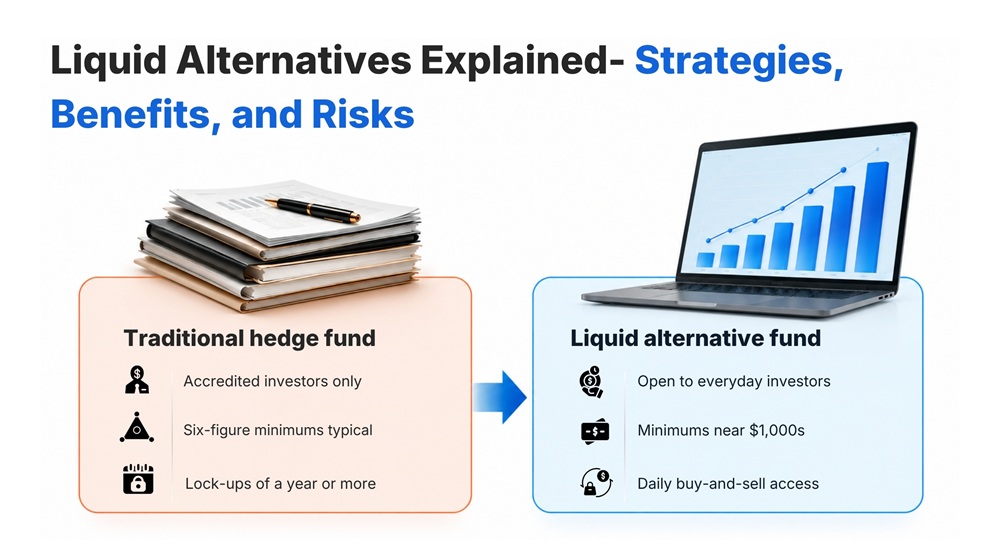
While the term seems straightforward, liquid alternatives encompass a broad range of strategies, and the label alone offers limited insight. Traditional hedge funds usually aren’t built for ordinary investors, since they may require accredited-investor status, set steep minimums, and restrict withdrawals for years. A liquid alternative tries to offer similar strategy exposure without most of that friction. Registered under the Investment Company Act of 1940, these funds generally price daily, disclose holdings on a set schedule, and accept minimums closer to what a regular mutual fund would ask.
Liquidity is really the defining difference here. A private hedge fund might lock up an investor’s money for a year or longer, while the mutual fund or ETF version of a similar strategy can usually be bought or sold on any trading day under normal conditions. The underlying investments can remain complex, while the fund structure makes it easier for investors to enter or exit their positions.
The market includes three main structures, open-end mutual funds, ETFs, and interval funds, each with its own liquidity and trading rules. ETF Database’s Alternatives ETF List tracked 198 U.S.-listed alternatives ETFs as of September 2026, with the largest single fund, the iShares Systematic Alternatives Active ETF, holding close to USD 5.9 billion in assets. Numbers like that show how far this corner of the industry has grown from a niche sliver into a category large enough to track on its own.
Different funds implement liquid alternatives through distinct approaches.
The Main Strategies Used by Liquid Alternative Funds
There’s no single approach hiding behind this label. Two funds sitting in the same broad alternatives bucket can behave in almost opposite ways depending on what they’re actually doing under the hood.
Long/short equity managers buy stocks they expect to rise while shorting stocks they expect to fall, aiming to profit from the gap between winners and losers rather than guessing where the overall market goes next. Managed futures, sometimes called trend-following strategies, run systematic models across equities, currencies, rates, and commodities, shifting long or short as momentum shifts. Market-neutral funds try to strip out broad market exposure almost entirely so returns hinge on a manager’s specific calls rather than which way stocks move, though that structure doesn’t make them risk-free. Event-driven funds chase corporate catalysts, mergers, spin-offs, restructurings, betting a manager can read how a given situation resolves. Multi-strategy funds fold several of these approaches into one portfolio, spreading return sources instead of leaning on one thesis.
Performance across these approaches can swing widely. YCharts’ Liquid Alt Fund Leaderboard for June 2026 found that the ten best-performing funds in this category had beaten the Standard & Poor’s 500 Index (S&P 500) by at least 2.5 times over the prior year. That figure is worth noting, particularly because it highlights how much fund managers’ expertise can influence results compared with simply tracking an index. Managers chasing results like that lean on derivatives, short positions, and leverage within regulatory limits, tools a plain long-only fund simply doesn’t have, which is also exactly what makes these strategies harder to evaluate from the outside.
Where Alternative Strategies Can Help with Diversification
At its core, the goal of these strategies is to enhance diversification. A traditional portfolio leans on stocks and bonds moving somewhat independently, and that works fine until it doesn’t. The problem shows up when both fall together, which is exactly what investors experienced in 2022.
BlackRock’s research, using Morningstar Direct data through June 30, 2026, found that the Bloomberg U.S. Aggregate Bond Index posted negative monthly returns in 17 of the 19 months when the S&P 500 dropped by 2 percent or more. Bonds are supposed to cushion equity losses. When that stops working, investors go looking for something else that will.
That’s the gap these strategies are meant to fill, at least in part. Some can profit whether markets rise or fall; others key off relative price movements or specific corporate events rather than direction at all. The goal is not to eliminate losses, but to reduce how heavily a portfolio relies on stocks and bonds behaving in the same way. Investors sometimes call this return smoothing, though the phrase oversells it a bit; nothing removes volatility completely. What it comes down to is holding assets that don’t all answer to the same market conditions.
Why This Category Is More Accessible Than Private Funds
Alternative strategies used to be reserved mostly for institutions, wealthy individuals, and family offices, kept behind steep minimums and long lock-ups. Liquid alternatives funds made these strategies more accessible to a broader range of investors. Minimums now often sit close to what a standard mutual fund requires, sometimes just a few thousand dollars, a fraction of what a private hedge fund might demand, and investors aren’t stuck waiting years to get their money back. Registered funds also carry disclosure requirements that make prospectuses and fund documents available in a way private reporting rarely matches.
Tax season tends to be simpler too. Registered fund investors typically get a standard Form 1099 at year-end, while private partnership investors often deal with Schedule K-1 forms that arrive late and complicate filing. Fees aren’t necessarily cheap, but many of these funds charge a flat management fee without stacking a separate performance fee on top, a structural break from the classic hedge fund model.
Capital flows reflect this transition. AQR CAPITAL MANAGEMENT’S Liquid Alts Roundup for the first quarter of 2026 reported USD 2.7 billion in net inflows for the quarter and USD 8.2 billion over the trailing twelve months, a sign that strategies once locked behind private channels are drawing steady interest through public vehicles.
The Risks Investors Should Not Ignore
None of this comes free of risk just because it’s more accessible. These funds can be genuinely hard to evaluate, particularly for investors unused to thinking about derivatives, leverage, or short selling, and results between managers can vary far more than most people expect. Strategy drift is one thing worth watching, since a manager who built a strong long/short track record doesn’t automatically carry that skill into a broader multi-strategy mandate once the fund’s scope expands.
Manager dispersion compounds the issue. AQR’s research on liquid alternatives found that the ten largest funds in certain Morningstar alternative categories can account for roughly two-thirds to 100 percent of total category assets, leaving investors in narrower categories with fewer credible options.
Costs matter more than people tend to assume. Alternative strategies typically run higher management fees than a basic index fund, and even a modest gap compounds meaningfully over a long holding period. Then there’s the liquidity mismatch itself, since a fund might offer daily redemptions while holding positions that would be genuinely hard to unload in a real crisis. Under calm markets, that rarely surfaces as a problem. It becomes one fast when a lot of investors try to exit at once, and the underlying market’s liquidity dries up at the same time. Not every fund runs into this, but understanding what a fund actually holds matters far more than how often the prospectus says you can redeem.
Considering these risks, how much should investors allocate to liquid alternatives?
How Much Should Investors Allocate?
There isn’t a single right number. Practitioner guidance generally puts alternative allocations somewhere between 5 and 20 percent of a portfolio, depending on risk tolerance, time horizon, financial goals, and existing exposure to stocks and bonds. What works for one portfolio might be wrong for another.
Real-world allocations still lag what guidance suggests. BlackRock’s 2026 Spring Investment Directions report found that advisers who use alternatives allocate around 7 percent on average, and only 52 percent of moderate-risk portfolios include any alternative exposure at all. Interest keeps climbing, but adoption hasn’t caught up.
Due diligence matters as much as the allocation decision itself, and that means looking past recent returns to how a manager has performed across different market environments, how transparent the fund is about positioning, whether correlation holds up in practice, and how total costs stack up against passive options. Pensions, endowments, and family offices have run these strategies for years. What’s newer is the growing pull from retail investors and their advisers, which makes the research step even more important, not less.
Are These Funds Worth a Place in a Long-Term Portfolio?
Liquid alternatives give investors access to strategies a plain stock-and-bond portfolio can’t easily replicate, through structures far more approachable than the private funds that pioneered these techniques. The trade-offs are just as real, since fees can run above passive benchmarks, performance varies sharply from one manager to the next, some strategies aren’t always easy to understand, and daily liquidity doesn’t guarantee the underlying holdings are just as liquid.
Liquid alternatives are designed to serve specific portfolio objectives rather than simply pursue higher returns. Their role may include improving diversification, reducing dependence on traditional assets, or managing portfolio volatility. Investors should evaluate the strategy based on the purpose it is expected to serve rather than treating it to beat the market. Fund managers’ expertise carries a lot of weight in that outcome, often more than the choice of strategy itself, since two managers running similar mandates can produce very different results. The allocation should fit the portfolio it’s going into rather than mirror someone else’s plan, and it’s worth revisiting periodically since markets shift and strategies don’t always hold up the same way twice.
The Fourth Annual CAIS and Mercer Alternative Investment Survey found that 88 percent of advisers plan to increase their allocation to alternatives over the next two years, which suggests this conversation isn’t going away soon.