Introduction
Mergers and acquisitions are no longer being influenced by market logic or financial opportunity; they are now being influenced more by politics, policy, and power. Amidst the growing global geopolitical unrest, boardrooms are currently considering instability risks as seriously as deal synergies. As alliances shift to sanctions and trade limits evolve, cross-border transactions have become significantly more complex. The impact of trade wars on the world economy is now a critical lens for predicting how the global dealmaking will take the next turn.
The Rise of Strategic Nationalism in Dealmaking
The narrowing band of global geopolitical tensions has forced growing number of countries to seek more economic sovereignty than open-market cooperation. Governments are adopting regulatory instruments to protect vital industries like energy, military, and technology against foreign interference. This strategic nationalism wave is turning the nature of mergers and acquisitions so that it now determines who can purchase as well as what can be purchased.
-
Stricter foreign investment screening: Nations are now screening cross-border transactions to determine the potential threat to national security and the stability of the supply chain. In other industries such as semiconductors, telecom, and defense technology, approval is becoming conditional or rejected altogether. This increased caution has slackened deal times and lowered transaction volumes, particularly in those markets that are strategically infrastructurally linked.
-
Protection of domestic champions: Governments are now implementing policies that promote domestic mergers to increase national competitiveness. They want to create self-reliant ecosystems that can withstand external shocks by assisting local consolidation and preventing foreign takeovers. The change is establishing a new frontier where M&A decisions have to get along with political agendas and economic logic at the same time.
Shifting Capital Flows and the Geography of Deals
Increased geopolitical tensions across the globe have made investors review their approach and place of capital deployment. The dealmakers are shifting out of the traditional hubs that previously controlled the cross-border mergers and acquisitions. The investment strategies are now being transformed by shifting alliances, alteration of trade policies, and restructuring of supply chains.
Regional Realignment of Capital: Inflows of funds by investors are shifting toward politically stable markets and those that have stronger economic cooperation frameworks. Southeast Asia and the Middle East are emerging as the new favorite destinations of capital in search of predictable regulatory conditions.
-
Emerging Deal Hotspots: Beyond the traditional Western markets, emerging economies are gaining momentum, with increased local demand and incentives created by the government. These are good regions that have friendly tax conditions and infrastructural development facilities that ensure the sustainability of acquisitions.
-
Risky Cross-Border Activity: The foreign investments have been scrutinized, and some multinational buyers have become apprehensive. Deals once motivated by global expansion are being postponed or restructured to reduce regulatory exposure. Companies are placing more emphasis on alliances and joint ventures in aligned markets to ensure that they can retain access and reduce political risk.
The Trade War Ripple: How Tariffs and Sanctions Reshape Value
Global trade conflicts are transforming the way companies consider and accomplish mergers and acquisitions. The impact of the trade war on the global economy extends to tariffs, valuation methods, the cost of capital, and long-term strategic planning. The more unpredictable the regulations, the more dealmakers need to incorporate political risks and operational breakages in their pricing models.
-
Supply-chain interruption: Tariffs cause companies to diversify their suppliers, which increases their lead time and operating costs. The outcome; reduced trust in valuations, particularly in those industries that are dependent on cross-border inputs.
-
Cost of capital: The trade war has increased the volatility of markets, which increases the cost of borrowing and makes it more difficult to finance deals. Companies are now incorporating political-risk premiums in their discount rates to reflect this risk.
-
Valuation adjustments: Buyers need greater due diligence of tariff risk, and sellers need to justify prices in volatile markets. According to the “Global CEO Outlook Survey September 2025,” 57% of CEOs expect geopolitical and economic uncertainty to last beyond 12 months.
Corporate Strategy Recalibrated: From Global to “Glocal”
In the current geopolitical environment of increased tensions, firms are shifting towards small, regionalized forms of operation. These models strike a balance between global coverage and local sensitivity. The strategy is no longer about cost reduction or expansion. Rather, mobility, stability, and regulatory alignment have become the priorities of leaders now.
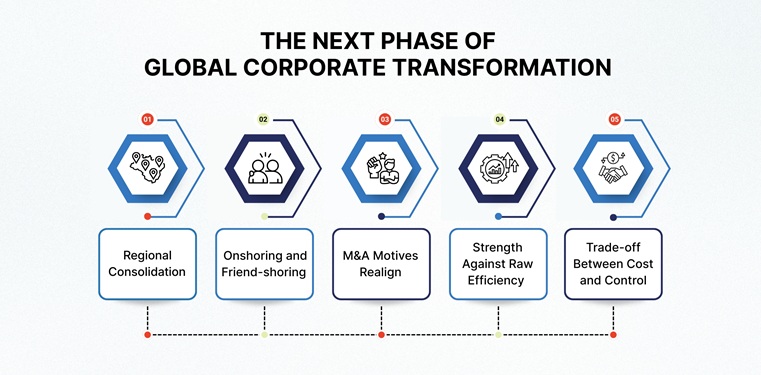
Some of the strategic changes are:
-
Regional consolidation: Companies are restructuring to have production, distribution, and service activities closer to core markets. This minimizes the risks of world-supply shocks, tariff risk, and foreign-policy changes.
-
Onshoring and friend-shoring: Previously purely cost-reduction moves are now motivated by the necessity to match politically and economically favorable jurisdictions to aid in the reduction of external risk.
-
M&A motives realign: Acquisitions that were earlier focused on market expansion are now also focused on resilience and supply-chain security. The focus of acquisition is now on local capabilities, logistics hubs, or regional service platforms.
-
Strength against raw efficiency: According to the 2025 Global Supply Chain Landscape and Trends report, approximately 34 percent of companies have moved to “friendshoring” to diversify geopolitical risk.
-
Trade-off between cost and control: Executives have learned that purely global models can open organizations to unforeseen trade policy changes or currency changes. The global strategy is the so-called glocal strategy, which focuses on operations that can be controlled, and yet capital, technology, or talent that are beneficial worldwide can be accessed.
Sector Spotlight: Winners and Losers Amid Geopolitical Shifts
The redesigning of the world partnerships and the trade priorities has made apparent losers and winners in the industries. Industries that conform to the national interests, resource security, and technological independence are on the rise. Other industries, on the contrary, are subject to more scrutiny and doubt in transactions.
-
Energy and defense remain the best performers as governments are concerned with energy independence and national security. The consolidation in these industries is accelerating with the support of the policies and long-term contracts that introduce the stability of the cash flow. Strategic partnerships have increased, especially in the defense sector, as nations develop in-house production and reduce dependency on external suppliers.
-
Semiconductors and technology have more difficult challenges. Acquisition plans are shaken by export controls and cross-border restrictions. The dealmakers of these sectors are moving on to regional cooperation to mitigate the regulatory risk and protect intellectual property. According to the 2025 M&A outlook from WilmerHale, the global average technology deal size climbed 9% to US$44.3 million.
-
The development of renewables and infrastructure is a bright spot. The governments are still infusing funds into sustainable energy and resilience of the system and creating conducive grounds for mergers and partnerships in green infrastructure.
Conclusion
In the contemporary disjointed environment, dealmakers are restructuring strategies to stay up-to-date with global geopolitical pressures. Agility, predicting regulatory changes, diversification of supply chains, and consideration of political exposure are now the keys to success in mergers and acquisitions, rather than the potential profit. Firms are putting more emphasis on resilience as opposed to growth, as they realize that flexibility is the real competitive advantage in a world where the effects of trade wars still resonate in every significant deal.