Within investment banks, the Financial Institutions Group specializes in advising banks, insurers, asset managers, broker-dealers, specialty lenders, and financial technology companies. Demand for that kind of advice remained visible in 2026, when global financial services recorded seven announced transactions above USD 5 billion from January through May, according to PwC’s 2026 mid-year outlook on financial services M&A.
The question of what FIG in investment banking is beginning with the client base. These institutions treat capital as input and product, so advice on mergers and funding must account for leverage and solvency in ways other sectors seldom require.
Many large banks organize these teams by vertical, with separate coverage groups for banks and insurers, so that advisors build deep technical knowledge of one client type. FIG investment banking also carries its own regulatory constraints and valuation conventions, along with a career structure that rewards specialization over time.
Institutions Covered by FIG Teams
The Federal Deposit Insurance Corporation reported 4,238 insured commercial banks and savings institutions in its Quarterly Banking Profile for the second quarter of 2026, providing a range of banking clients for FIG teams, from universal banks to community lenders with a few branches.
The second group consists of insurers, which include all life carriers, property and casualty underwriters, reinsurers and specialty insurers. Specialty finance companies are lenders other than the largest banks that finance markets that are too small, or too odd, for the largest banks, and include credit card companies and aircraft leasing companies. These clients are sensitive to market activity and the fees earned by asset managers and custody banks are based on assets managed, and broker-dealers and exchanges are based on volume of transactions.
The boundaries defining neighboring banks vary depending on a client’s economic characteristics relative to traditional lenders. Payment processors and financial software companies are similar to tech companies, so some companies may allocate them to tech coverage. Equity REITs are part of the real estate groups while the mortgage REITs remain a part of FIG because they are lenders and generate income from the spread between the interest rate.
Core Transaction Types in FIG Investment Banking
A European bank’s USD 12.2 billion acquisition of a U.S. commercial bank in the first half of 2026 shows the mergers and acquisitions mandate at large scale. White & Case’s U.S. public M&A update for that period describes this transaction as the third-largest U.S. bank deal since 2010. Advisors on a transaction of that kind align valuation and consideration structure with the regulatory timetable.
FIG investment banking mandates are divided into several categories.
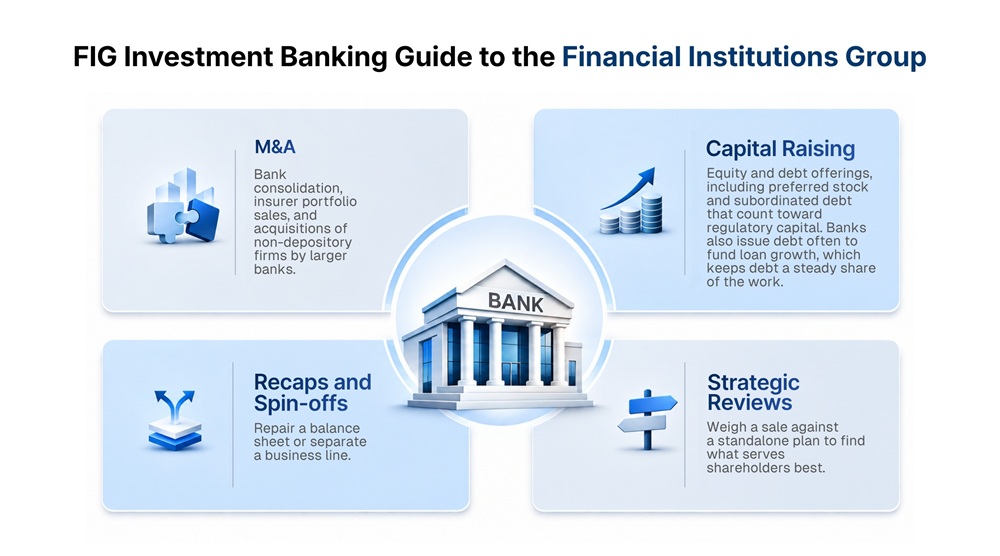
- Mergers and acquisitions cover bank consolidation and insurer portfolio sales, along with purchases of non-depository firms by larger banks.
- Capital raising spans equity and debt offerings, including preferred stock and subordinated instruments that count toward regulatory capital. Banks also issue debt frequently to fund loan growth, which gives debt issuance a steady share of the work.
- Recapitalizations and spin-offs address balance sheet repair and the separation of business lines, while strategic reviews assess whether a sale or a standalone plan serves shareholders best.
Large commercial banks generate many debt transactions and relatively few mergers of scale, while mid-sized and community banks produce most of the consolidation. Leveraged buyouts remain uncommon because these institutions already carry heavy leverage and strict regulatory limits, so private equity firms more often acquire minority stakes.
Banks Versus Insurers as Advisory Clients
The spread of interest banks receive on loans and interest they pay on deposits, and debt makes up their income. Rate sensitivity is also a consideration in merger discussions as it has an impact on the operating results and on the market value of securities held. Loans and deposits are significant items on a bank’s balance sheet, and investment portfolios are the dominant items on an insurance company’s balance sheet, which are backed by policy reserves.
Insurers receive the premium first and pay claims afterwards, earning interest on the money in between. The reserve adequacy and longevity assumptions impact when a carrier considers a sale or reinsurance transaction as property and casualty claims can settle in a few years and life policies can last for decades. Insurers also follow an underwriting cycle, and new competitors typically drive down rates until a catastrophic loss eliminates the weaker firms and drives up rates.
Buyer universes diverge. Bank targets draw other banks along with credit unions and a smaller group of non-traditional acquirers, and buyers evaluate targets on returns and capital ratios. Insurance attracts strategic carriers and private capital. PwC’s U.S. insurance deals outlook for 2026 recorded USD 29.6 billion in announced value across 191 disclosed transactions from December 1, 2025, through May 31, 2026, and buyers in that sector weigh combined ratios and written premium growth.
Capital Rules and Regulatory Approvals Shaping Deal Structures
Capital regulation sets the boundaries of what a financial institution can do. Under Basel standards, banks hold common equity tier 1 capital against risk-weighted assets, and the Federal Reserve tests those holdings each year against a hypothetical recession. In its 2026 Federal Reserve Stress Test Results, the aggregate common equity tier 1 ratio of 32 large banks was projected to fall from an actual 12.8 percent to a minimum of 11.2 percent under the severely adverse scenario, a decline of 1.6 percentage points.
This is not the case for insurers. In contrast, solvency regimes like the U.S. risk-based capital regime correlate capital requirements with the risk that the carrier takes and invests in.
They are subject to a number of approvals by various authorities, and insurance mergers may need multiple state commissioners to approve, extending timelines. Capital ratios also determine deal size because an acquirer must demonstrate that the total capital will be adequate following the transaction. Capital targets restrict the growth of loans and payouts to shareholders, thereby restricting the client’s ability to fund itself. Banks often raise capital when they are required to do so by annual stress testing results as they adjust their capital ratios. Many mergers in this sector will be driven to stock consideration by low cash balances and already high leverage, which impacts ratios as well as price and structure.
Equity-Based Valuation Methods and Multiples
Median price to tangible book value stood at 1.45x for U.S. bank, savings bank, and thrift transactions in the second quarter of 2026, according to Wipfli Corporate Finance Advisors’ Financial Institutions Q2 2026 M&A Update. Multiples of that kind set the reference point for bank price negotiations.
Enterprise value gives way to equity-based measures because deposits and borrowings function as operating inputs for a financial institution and cannot be separated from the business the way debt can for an industrial company. Price to tangible book value and price to earnings serve as primary measures in bank analysis, while return on tangible common equity explains premiums and discounts between institutions. A regression of price to book against return on equity is a common cross-check.
Dividend discount models replace the discounted cash flow approach, since free cash flow carries little meaning when nearly every cash flow item reflects reinvestment in the business. Life insurers add embedded value models, which project the value of policies already in force. Precedent transactions and comparable company screens apply after adjustments for capital levels and credit quality.
Career Progression and Technical Skills
Career paths in FIG correspond to established banking roles.
- Analyst: financial modeling, pitch materials, and data work.
- Associate: transaction execution and analyst oversight.
- Vice president and director: client coverage and deal structuring.
- Managing director: relationship ownership and origination.
Technical requirements are different from generalist groups. Candidates read bank loan loss accounting and insurer unearned premium reserves fluently, and they need working knowledge of Basel III and liquidity standards. Clients are highly analytical, so the ability to communicate accurately and to understand trends in credit and interest rates is important.
Compensation is keeping pace with the broader investment banking advisory market. In May 2026, Johnson Associates estimated that incentive pay for investment bankers advising companies will increase 10 percent to 20 percent or more from a year ago.
The focus of exit routes is financial services. Private equity firms and hedge funds specializing in financial services recruit from FIG, as do corporate development teams of banks and insurers. The longer people stay in a group, the less likely they will be able to find a generalist buy side position.
Closing Perspective on the Financial Institutions Group
Professionals and candidates weighing the Financial Institutions Group can test their fit against four considerations.
- Interest in learning accounting and valuation conventions that most other groups never use.
- Comfort with a recurring client base that returns for capital raising and advisory work over many years.
- A career direction that favors financial services, since the skill set carries most naturally into that field.
- Readiness for a demanding schedule, because regulatory scrutiny and time-sensitive deliverables keep the pace high.
Candidates meeting most of these criteria should prepare by reviewing published financial statements of banks and insurers and speaking with current bankers in the group. Specific industry experience carries greater weight in MBA and lateral hiring.